.webp)

USCIS Certified Translation Services: A Complete Guide for Immigration Document Requirements

Summary
Choosing the right translation services company in 2025 is important for businesses and individuals who need accurate and reliable language support. Translation is no longer just about converting words; it involves cultural understanding, subject-matter expertise, and consistency across different types of content. Companies often rely on professional translation agencies for legal documents, marketing materials, medical records, and technical content. Certified translation agencies are especially important when documents must be accepted by courts, government agencies, or educational institutions. When evaluating translation services companies, it helps to look at their experience, certifications, industry specialization, and the qualifications of their translators. Turnaround time, quality control processes, and customer support also play a key role. Working with an established translation company helps reduce errors, delays, and misunderstandings. The right partner ensures translations are accurate, culturally appropriate, and suitable for official or professional use across global markets.
Introduction
When you apply for immigration benefits, perhaps the most critical thing is that your foreign documents be accurately and certifiedly translated. The USCIS hardly ever recognizes translations not done by certified translators. This certification guarantees that the individual translating your document is properly equipped to do so and also that the document rendered in English is equivalent in meaning to the document in the foreign language. Above all, it ensures that there are no mistakes in the translation, as even slight errors can carry huge implications in the context of immigration. Connected Translations is a provider of translation services that you can trust.
1. What is USCIS Certified Translation?
Translations that meet USCIS standards refer to a service that transforms living and dead languages into English. When you apply for immigration, not only must certain documents be translated into English, but those translations—especially of vital records, like your birth certificate—must be done by a service that meets USCIS standards. Otherwise, your application may be delayed or even rejected.
USCIS-certified translations have these key features:
Precision: USCIS insists that translations are true to the document being translated. Every word, phrase, and detail must be rendered exactly without changing the substance of the original.
Certified Translator: A certified translator must provide the translation. This is crucial as the translator’s credentials attest to their proficiency in both languages and ensure the translation meets legal standards.
Statement of Certification: A statement must accompany the translation from the translator certifying that the translation is accurate and complete. This statement—which usually also gives the translator’s qualifications and contact information, as well as a signature—acts as a kind of notary for the translated document.
Acceptability for Official Use: USCIS does not accept translations from unqualified individuals or online tools. Translations must be provided by professionals recognized for official use. They ensure that the immigration process runs smoothly.
A legal requirement exists for any non-English document that is part of an immigration petition to be translated into English by a translator who is certified by USCIS. This is a good reason to be careful in choosing a translation service.
2. Why is USCIS Certified Translation Important?
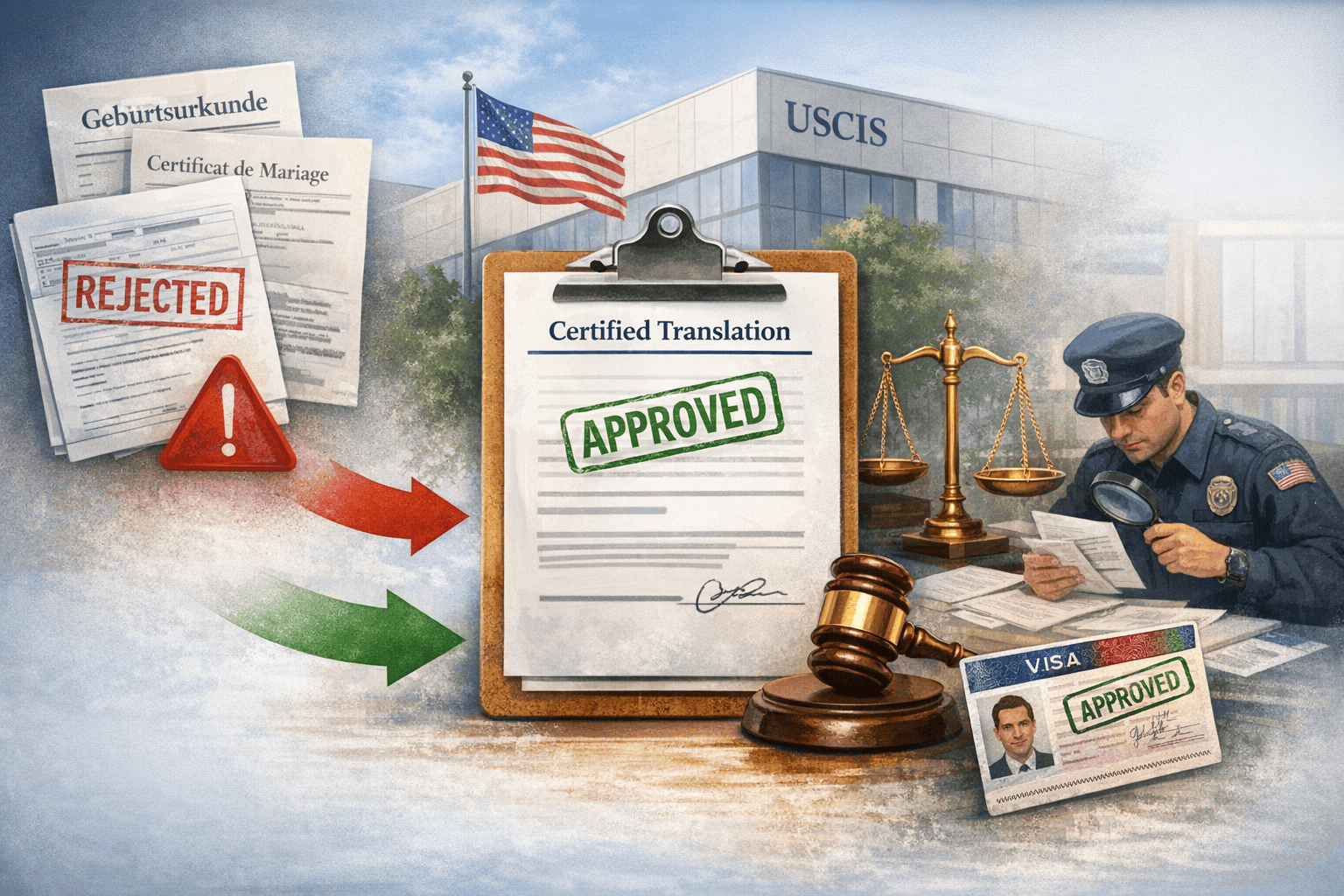
A pivotal step in ensuring that your immigration application is not subject to delays or complications—and gets processed as smoothly as possible—is something called certified translation. Here are a few reasons why certified translations are important, necessary, and even required.
Acceptance by Law: USCIS mandates that any document not written in English must be accompanied by a certified translation. This guarantees that the information contained in the original document is translated and conveyed with optimal accuracy. And that means your application is valid.
Rejection or Delays May Result If: You submit documents that are not properly translated.
Avoid this by making sure that all documents not in English are:
• Translated by someone who is qualified and understands both the source and target languages.
• Correctly formatted as translations. USCIS expects the translations to look a certain way, and they have a few templates in mind. Follow their lead!
Maintaining Uniformity and Transparency: A guaranteed translation ensures that the particulars in your documents—like appellations, times, and other essential identifiers—come through uniformly and transparently in English. This is vital, given that the Consular Section makes its determinations based on your submitted materials.
When documents are submitted to USCIS, they must meet specific standards. Only translations provided by certified translators are accepted for official use. This is a significant step toward ensuring that all documents are processed, recognized, and accepted for legal purposes.
If, for instance, you submit a birth certificate, marriage certificate, or another official document that is not in English, then USCIS will require you to submit a translation that is approved by USCIS to ensure your application is both accurate and legal.
3. Key Requirements for USCIS Approved Translation
For your document translation to be accepted by USCIS, it must meet certain standards. Some key requirements for USCIS-approved translation are as follows:
A Certified Translator Must Do the Translation: Translators must be fluent in both languages (source and target). USCIS requires that translations be done by certified translators. Translators must be able to attest to the accuracy of the translations they produce.
Statement of Certification: A translation must have with it a statement certifying the translation’s accuracy. This statement must say that the translation is accurate, complete, and true to the original, to the best of the translator’s knowledge.
Accuracy and Fidelity: All document details must be translated correctly and carefully. The USCIS does not accept “summary” translations; every word, including dates and official titles, must be translated exactly, with no errors or misinterpretations.
No Changes or Additions: A certified translation cannot include changes or additions to the original text. It must reflect the exact wording of the original document in English, including any specialized terminology.
The translation must correspond to the layout of the source document as closely as possible. This serves to guarantee that the translated document is readily readable and corresponds to the same layout as the original. This makes it much easier for citizens of the U.S. to assess.
Backing Documents: If a document includes intricate nomenclature, shorthand, or specialized language, the translator must furnish explanations or clarifications as part of the translation. This guarantees that the translation is readily comprehensible to officers at USCIS.
Selecting a professional translation service such as Connected Translations guarantees that all of these stipulations are satisfied and that your documents are completely compliant with USCIS standards.
4. Common Documents That Require USCIS Certified Translation
Numerous document types can often necessitate certified translations for USCIS. Among the most common documents requiring translation, we frequently find these:
Birth Certificates: A birth certificate is a basic document necessary for a lot of immigration applications, particularly those for family-based petitions. If your birth certificate is not in English, then you need to provide a translation of it that is certified by the USCIS.
Certificates of Marriage: Like birth certificates, marriage certificates are essential for any petitions where the petitioners are spouses or family members. Not only must the translation be correct, it must be certified, with the translator taking full responsibility for the content, if it is to be accepted by USCIS.
Decrees of Divorce: For persons applying for immigration benefits and who have been previously married, divorce decrees are needed. USCIS requires a certified translation to ensure the document is accurately represented.
Records from the police: Individuals who seek particular immigration benefits may need to obtain police clearance and/or criminal records from foreign countries. Such documents must be translated and certified.
Transcripts: If you are applying for a student visa or other educational reasons, USCIS needs certified translations of your academic records. They must be academic or professional equivalent, and they must be recognized as equivalent by USCIS. If you are using a foreign degree to qualify for something in the U.S., and you are also using that degree to apply for a student visa or other educational reasons, you need to get the translation taken care of.
Petitions and Applications for Immigration: You must translate and certify any forms or documents that are part of your immigration petition when they are necessary and in the language of the original documents. This means that if you are asked to submit any of the forms listed below, you must not only fill them out but also ensure that they, along with any other requested documents, are in English and in a readable condition before you send them to the appropriate office.
This is especially true for these two forms: I-130 (Petition for Alien Relative) and I-485 (Application to Register Permanent Residence or Adjust Status).
Here are a couple of specimens of materials that might need translation certified by USCIS. It is very important to ascertain exactly what you need to do for each different type of document when you are sending it to them as part of your immigration process. Translation is sometimes more of an art than a science; when generous interpretations of meaning can be made, they often are.
5. Why Choose Connected Translations for USCIS Certified Translation?
Selecting a reliable and effective translation service is crucial when dealing with translation that must be certified by USCIS. This is because certain qualities must be present in the translation for it to not only be accurate but also to demonstrate legal compliance.
Let us explain what those qualities are, and why Connected Translations possesses them.
Certified Expert Legal Translators: At our company, we have certified translators working for us. These people have extensive experience translating legal documents and their certifications say they’re experts at it. Since immigration cases involve a lot of legal speak, having your documents accurately translated by experts is essential. Our certified translators ensure that happens.
Swift and Dependable: We recognize how crucial it is to meet deadlines in the immigration process. Our team provides top-notch translations at breakneck speed, enabling you to get your documents in just ahead of the due date.
Accurate and certified: We guarantee that all translations are right on the money, complete, and comply with all current USCIS requirements. Our certification ensures your documents are in prime condition for official use and will be accepted by those aloof immigration authorities.
Confidentiality: All translations are treated with strict confidentiality. Our translators ensure that all personal and sensitive information within the content they are translating is not disclosed in any way.
Full-Service Provider: Whether you need a translation that’s been approved by USCIS, a notarized translation, or just a simple legal document translation, we provide all the services you need to fulfill your immigration and legal requirements.
Selecting Connected Translations means that your translations certified by the USCIS are right the first time. Peace of mind is a powerful emotion, especially during the immigration process.
Conclusion
Translations recognized and processed correctly are vital to your immigration documents. If you want to ensure that your immigration documents make it to the right place and are understood there, then your documents need to be translated. They need to be translated by a person who knows what translation is, and that person particularly needs to know what translation is in the context of the law. And that person needs to have certifiable training as a translator. Or else your documents might go south.

Daniel Brooks is a New York City-based writer and content strategist with a deep curiosity for how language shapes connection across cultures. With over ten years of experience crafting digital content for global audiences, Daniel brings a thoughtful and practical voice to the Connected Translations blog.