.webp)

How Translating Official Documents Differs from Standard Translations

Summary
Not all translations are created equal—especially when official documents are involved. Translating documents like birth certificates, marriage records, contracts, or immigration paperwork requires far more than basic language skills. Unlike standard translations, official document translations must meet strict legal, formatting, and accuracy standards set by government agencies, courts, and institutions such as USCIS. Even small errors—like mistranslating a legal term or omitting a stamp—can lead to application delays, rejections, or legal complications. This guide breaks down the key differences between standard and official translations, explains why certified translations are often mandatory, and highlights common mistakes people make when translating important documents. You’ll also learn how professional translation services help preserve legal meaning, comply with government requirements, and ensure documents are accepted the first time. If you’re dealing with immigration, legal, or official paperwork, understanding these differences can save time, money, and unnecessary stress.
Introduction
Translating official documents requires more than just language fluency. It demands precision, accuracy, and an understanding of legal and cultural nuances. Failing to properly translate official documents can lead to delays, rejections, and even legal issues. In this post, we explain how translating official documents differs from standard translations, why accuracy matters, and how working with a professional translation service like The Spanish Group ensures that your documents meet legal requirements and avoid costly mistakes.
1. The Key Differences Between Official and Standard Translations
When we talk about translating official documents, we’re referring to documents that are used in legal, governmental, or formal business contexts. These can include birth certificates, marriage certificates, immigration papers, contracts, and academic records. Here’s how translating these differs from standard translations:
- Standard Translations: These are general translations for personal or informal use. They can be as simple as translating a personal letter or a website description. The stakes for accuracy are lower, and the tone can be more flexible.
- Official Translations: These require precision and adherence to specific legal and cultural standards. The translator must accurately reproduce the meaning, context, and legal terms without any omissions or alterations. An official translation is often required to be certified to ensure its authenticity and compliance with legal standards.
For example, if you’re submitting an immigration application and need to translate a birth certificate, the translation must not only be accurate but also legally valid. Mistakes can lead to delays in the immigration process, or worse, a rejected application.
Key Takeaway: Official translations require higher accuracy and legal compliance than standard translations.
Green Subsection:
Accuracy and Legality Matter Most in Official Translations
2. Why Precision is Crucial When Translating Official Documents
For most translations, the goal is to communicate the meaning of the original text. However, when it comes to translating official documents, it’s much more than just understanding the words. It’s about ensuring that the legal meaning and the document’s integrity remain intact. Here’s why precision is so important:
- Legal implications: Many official documents, such as contracts, certificates, or court orders, have legal consequences. Even a slight mistake can cause misunderstandings or legal disputes.
- Government requirements: Agencies like USCIS or courts require that official documents be translated accurately to avoid delays or rejections. They often won’t accept translations that aren’t certified or fail to maintain the official format of the original.
- Maintaining context: Certain terms and phrases have specific meanings in legal contexts that must be preserved in translation. For example, “witness” may have a different legal implication than “observer,” depending on the document.
Let’s say you’re submitting a divorce decree for immigration purposes. If the translator fails to capture the legal status of the divorce (e.g., not distinguishing between a final judgment and a temporary ruling), it can result in your application being delayed or rejected.
Key Takeaway: Official documents must be translated accurately to meet legal and government requirements, and even small mistakes can have significant consequences.
Yellow Subsection:
Government Agencies Require Legal Precision in Translations
3. The Legal Importance of Certified Translations
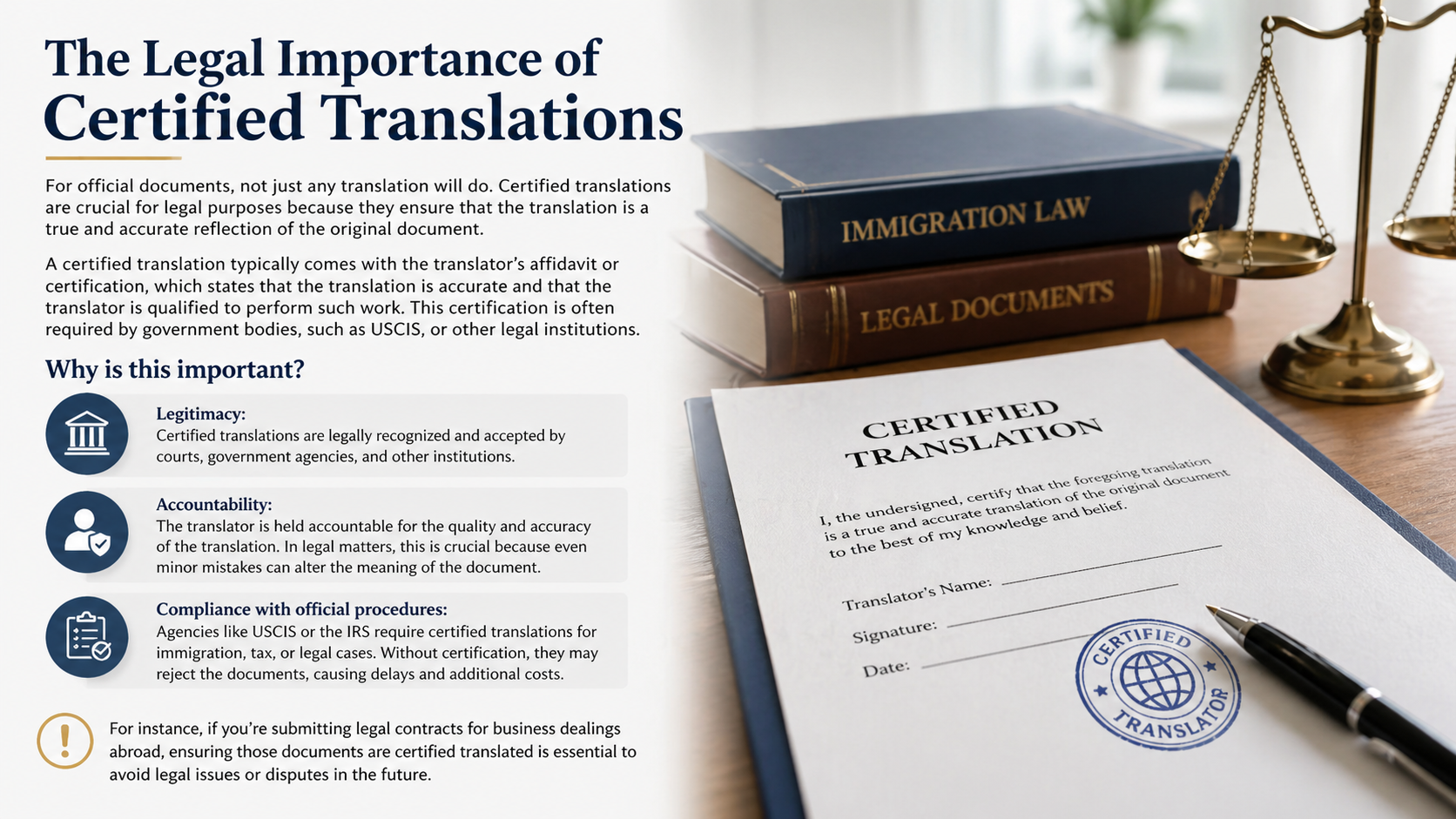
For official documents, not just any translation will do. Certified translations are crucial for legal purposes because they ensure that the translation is a true and accurate reflection of the original document.
A certified translation typically comes with the translator’s affidavit or certification, which states that the translation is accurate and that the translator is qualified to perform such work. This certification is often required by government bodies, such as USCIS, or other legal institutions.
Why is this important?
- Legitimacy: Certified translations are legally recognized and accepted by courts, government agencies, and other institutions.
- Accountability: The translator is held accountable for the quality and accuracy of the translation. In legal matters, this is crucial because even minor mistakes can alter the meaning of the document.
- Compliance with official procedures: Agencies like USCIS or the IRS require certified translations for immigration, tax, or legal cases. Without certification, they may reject the documents, causing delays and additional costs.
For instance, if you’re submitting legal contracts for business dealings abroad, ensuring those documents are certified translated is essential to avoid legal issues or disputes in the future.
Key Takeaway: Certified translations are a legal requirement for many official documents and help ensure that translations are accepted by government and legal bodies.
4. Common Pitfalls When Translating Official Documents
Even small errors in translation can have big consequences, especially when dealing with official documents. Here are some of the most common pitfalls people face when translating documents and how to avoid them:
- Inaccurate translations of legal terms: Legal terms are often not straightforward and can vary by jurisdiction. A term like “alimony” or “custody” might need to be translated differently depending on the context. Incorrect use can lead to misunderstandings or legal complications.
- Omitting important information: Sometimes, translators might omit or fail to translate part of the document. This can be a major issue when dealing with legal documents, where every word counts.
- Lack of proper formatting: Official documents often require a certain format to maintain their legal validity. A simple formatting mistake can result in your documents being rejected.
- Using non-professional translators: Not all translators are equipped to handle official documents. Using someone without legal expertise can result in errors that compromise the document’s validity.
Real-World Scenario: A business owner from Mexico needs to submit a contract for a commercial agreement with a U.S. partner. They use an online translator that doesn’t understand legal jargon, and the contract is rejected because of inaccurate terminology. This leads to delays, lost time, and potentially a failed deal.
Key Takeaway: Avoid errors by using professional translators who understand the nuances of legal and official documents.
5. How to Ensure Your Official Documents Are Translated Correctly
The best way to ensure that your official documents are translated correctly is to work with a professional translation service. Here are a few tips for choosing the right service:
- Look for certified translators: Ensure that the translators are qualified and have experience with legal and official documents.
- Verify experience in your field: Whether it’s immigration, legal, or business, your translator should have specific expertise in the area your documents cover.
- Ask for samples or references: Reliable translation companies, such as The Spanish Group, can provide references or examples of previous work to ensure quality.
- Ensure compliance with government standards: Work with a company that knows the specific requirements for submitting translations to government agencies like USCIS or the IRS.
At The Spanish Group, we specialize in official document translations and have a team of certified experts who ensure that every translation is legally compliant and accurate. Whether you’re dealing with immigration paperwork or international contracts, we guarantee that your translations will meet the highest standards.
Conclusion
When it comes to translating official documents, the stakes are high. Whether you’re applying for a visa, handling an estate, or dealing with legal contracts, you need translations that are precise, legally compliant, and certified. At The Spanish Group, we understand the importance of accurate and certified translations. Our team is ready to help you navigate the complexities of official document translations, ensuring that your documents are accepted by the appropriate authorities and move your process forward without delay.
Key Takeaways
- Official translations require more accuracy and legal compliance than standard translations.
- Certified translations ensure legal validity for documents submitted to USCIS or other legal bodies.
- The Spanish Group offers certified translation services for all official documents.