.webp)

The E-Commerce Localization Audit: 7 Mistakes Costing You Millions in the APAC Market

Summary
Many U.S.-based ecommerce companies lose revenue in Asia-Pacific markets because they rely on direct translation instead of full localization. In APAC markets, customers expect culturally adapted experiences, localized payment methods, region-specific terminology, and legally compliant content.
This guide explains the most expensive localization mistakes businesses make in APAC markets, the compliance risks companies often ignore, and how professional localization and certified translations can improve conversion rates and reduce operational risk.
Why Localization Determines APAC Revenue
Asia-Pacific markets represent one of the largest ecommerce opportunities globally. However, many companies fail to convert customers because they misunderstand the difference between translation and localization.
Translation converts language. Localization adapts the full customer experience to local expectations, including:
- Language and tone
- Cultural context
- Currency and pricing
- Payment methods
- User experience expectations
For example, an ecommerce website in Japan with awkward product descriptions, incorrect sizing, or unfamiliar payment instructions may lose customer trust immediately.
Certified translations are especially important for customer-facing legal and financial content such as:
- Terms and conditions
- Return policies
- Tax disclosures
- Payment instructions
Localization directly affects customer trust, conversions, and long-term market growth.
Key Takeaway: Successful APAC expansion requires full localization, not just translated text.
The 7 Most Costly Localization Mistakes
1. Overreliance on Machine Translation
Automated translation tools often fail to capture cultural context and regional expectations.
2. Ignoring Cultural Differences
Colors, symbols, messaging styles, and tone can carry different meanings across APAC markets.
3. Inconsistent Terminology
Using different terms for the same product or service can reduce customer confidence.
4. Poor Mobile Localization
Many APAC consumers primarily shop through mobile devices, making mobile-first localization essential.
5. Incorrect Currency and Pricing Display
Displaying foreign currencies or poorly adapted pricing creates friction during checkout.
6. Lack of Certified Legal Translations
Incorrectly translated legal and compliance documents can create regulatory problems.
7. Ignoring Local Payment Preferences
Different APAC regions often rely on region-specific payment platforms and transaction habits.
Key Takeaway: Small localization mistakes can create major conversion and compliance problems at scale.
The Compliance Risks Most Businesses Ignore
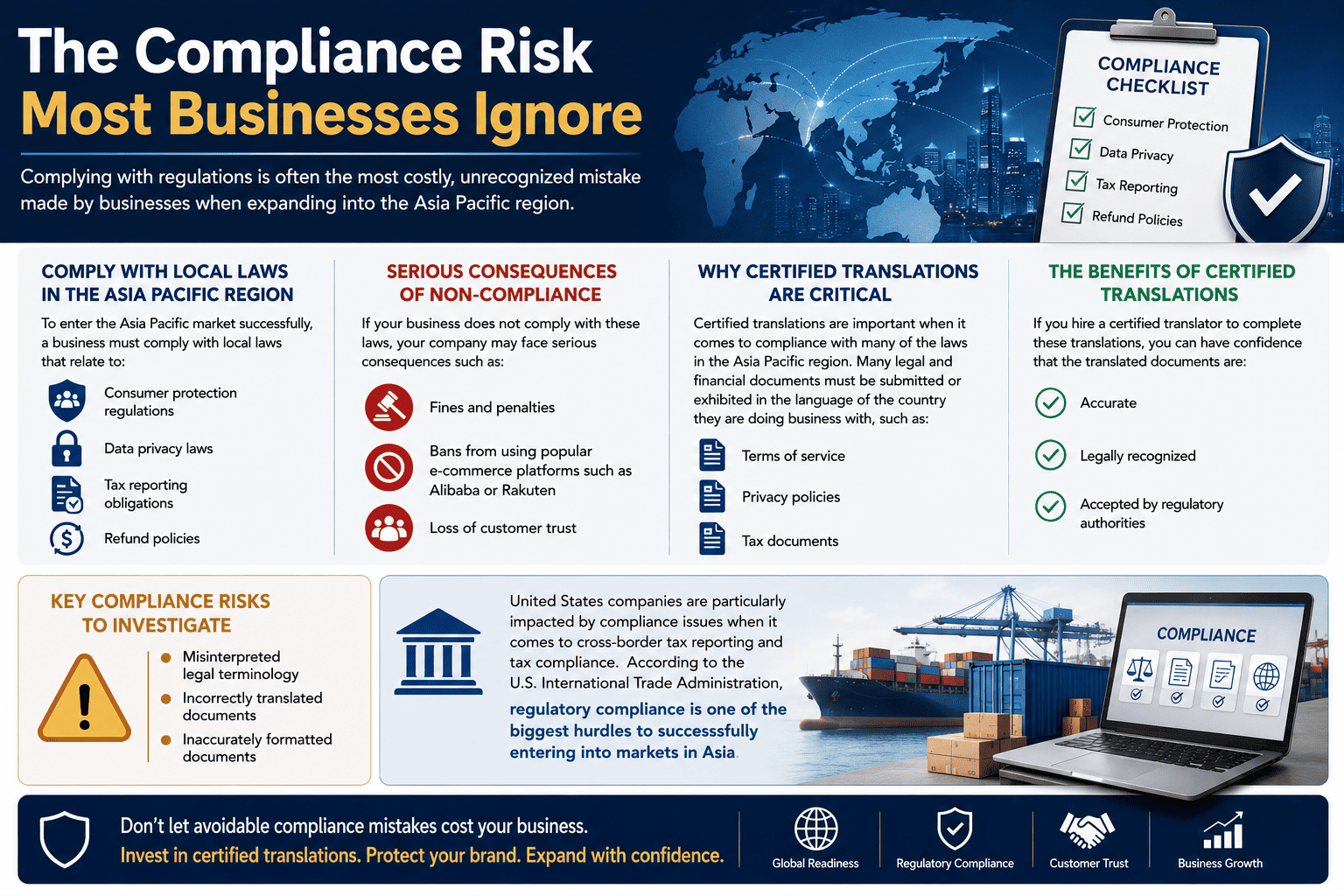
Compliance failures are one of the biggest hidden risks for businesses entering APAC markets.
Companies must comply with local regulations involving:
- Consumer protection laws
- Data privacy regulations
- Tax reporting requirements
- Refund and return policies
Failure to comply may result in:
- Financial penalties
- Platform restrictions
- Loss of customer trust
- Market access limitations
Legal and financial documents often require certified translations to ensure regulatory acceptance.
Examples include:
- Terms of service
- Privacy policies
- Tax documents
- Compliance disclosures
Using certified translators helps ensure that documents are accurate, legally recognized, and accepted by regulatory authorities.
Key Takeaway: Compliance translation mistakes can lead to legal exposure, fines, and loss of market access.
How to Improve Your Localization Strategy
Localization problems can often be corrected quickly when businesses take a structured approach.
Step 1: Perform a Localization Audit
Review your customer journey across:
- Website content
- Product pages
- Checkout systems
- Customer support experiences
Step 2: Prioritize High-Impact Problems
Focus on areas directly affecting conversion and trust, including pricing, product descriptions, and payment methods.
Step 3: Use Professional Translation Services
Work with experienced providers such as Connected Translations for certified and scalable localization support.
Professional services help with:
- Certified legal translations
- Localization strategy by market
- Industry-specific terminology
- Compliance documentation
Step 4: Standardize Terminology
Create translation glossaries to maintain consistency across platforms and languages.
Step 5: Test and Optimize
Use A/B testing and analytics to measure how localization improvements affect customer behavior and sales.
Key Takeaway: Localization should be treated as an ongoing revenue and compliance strategy.
Conclusion
APAC markets offer major growth opportunities for U.S.-based ecommerce businesses, but poor localization can quietly reduce conversions, damage trust, and create compliance risks.
Businesses that invest in professional localization, certified translations, and culturally adapted customer experiences are more likely to succeed in highly competitive international markets.
Localization is not just a translation task. It is a strategic business function that directly affects revenue, compliance, and customer trust.
At Connected Translations, we provide certified translation and localization services designed to support international ecommerce growth and regulatory compliance.
Key Takeaways
- APAC expansion requires full localization, not direct translation
- Certified translations help protect legal and financial compliance
- Poor localization reduces conversions and customer trust
- Localization strategy directly impacts revenue and market success