.webp)

Telehealth and Language Access: Why Virtual Care Still Needs Human Interpreters
Summary
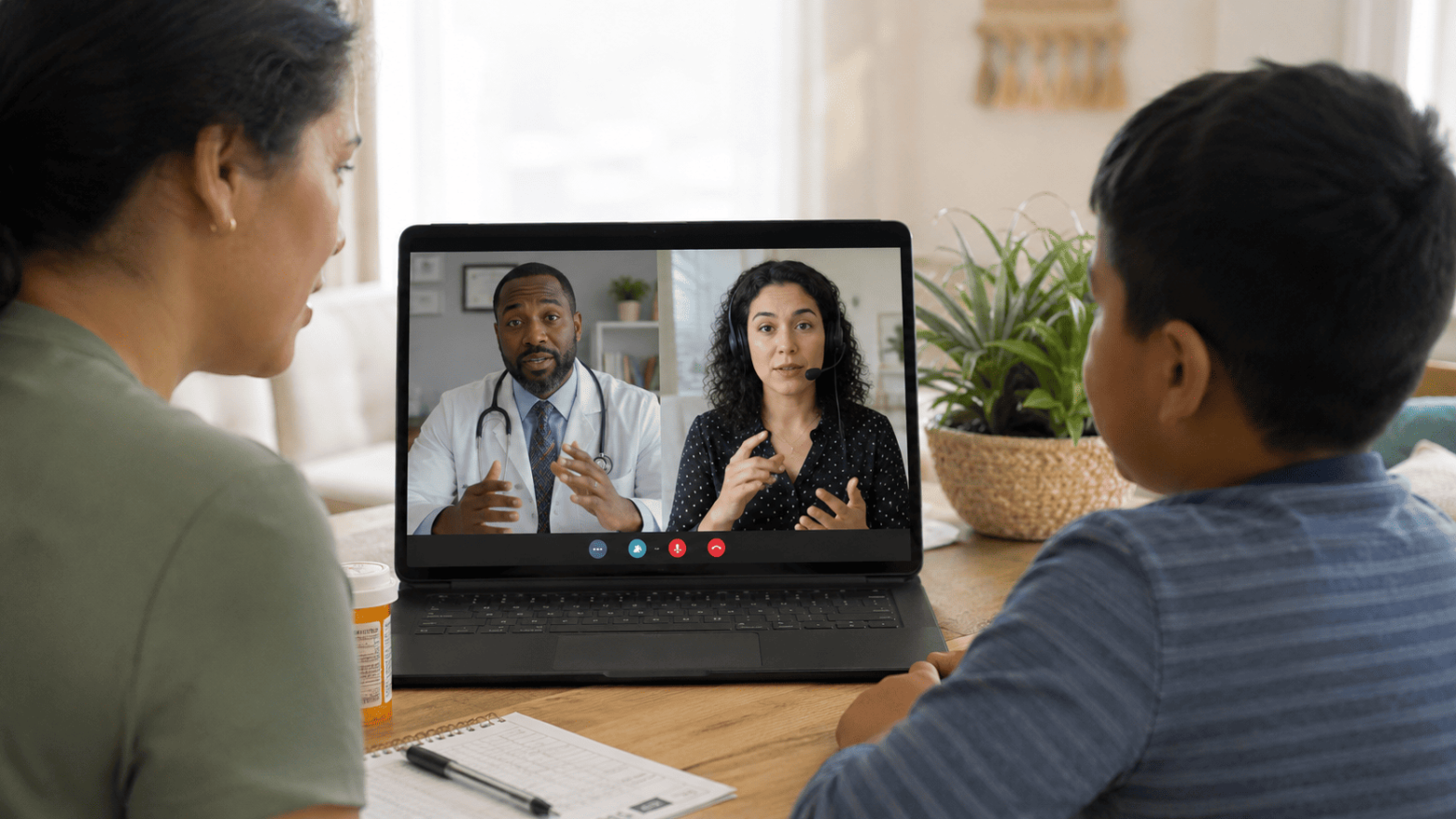
Telehealth has made healthcare more accessible, but language barriers remain a significant risk. When providers rely on AI or automated translation instead of human interpreters, patient safety can be compromised. This article explains why virtual care still requires professional interpreters and how communication failures in telehealth can lead to clinical and legal consequences.
1. The Dangerous Assumption Behind Telehealth: “If It’s Digital, It’s Understood”
Telehealth is now a permanent part of healthcare delivery in the United States. Virtual visits are widely used for primary care, mental health services, follow-ups, and chronic disease management.
However, a critical assumption continues to create risk:
Access to care does not automatically mean access to understanding.
Many healthcare providers believe that digital tools such as auto-captioning, AI transcription, or built-in translation features are sufficient to bridge language gaps. While these tools may assist communication, they are not designed for clinical accuracy.
This assumption can create serious safety risks for patients with Limited English Proficiency (LEP).
The U.S. Department of Health and Human Services (HHS) requires healthcare providers receiving federal funding to ensure meaningful access to care for LEP patients under Title VI of the Civil Rights Act.
This requirement applies equally to telehealth environments.
Patients must clearly understand:
- Diagnoses
- Medication instructions
- Treatment risks and benefits
- Follow-up care
- Informed consent discussions
The Centers for Medicare & Medicaid Services (CMS) also emphasizes that telehealth services must meet the same standards of access and quality as in-person care.
However, most telehealth platforms rely on automated systems that were never designed for medical precision. These tools often struggle with:
- Medical terminology
- Accents and dialects
- Context and tone
- Urgency in communication
- Multi-speaker conversations
Even a small misunderstanding in a virtual consultation can lead to incorrect treatment decisions or delayed care.
2. Why Human Interpreters Are Still Critical in Virtual Care
A medical interpreter is not simply a translator—they are a trained communication specialist who ensures accuracy, neutrality, and clinical clarity in real time.
In telehealth environments, their role becomes even more important because virtual care removes many non-verbal communication cues such as body language and physical presence.
Unlike automated tools, human interpreters can:
- Clarify unclear statements immediately
- Ask for repetition when needed
- Detect confusion in tone or response
- Adapt to cultural and linguistic differences
- Ensure accurate medical terminology transmission
This is especially important in high-risk scenarios such as:
- Emergency telehealth consultations
- Mental health therapy sessions
- Chronic disease management
- Post-operative follow-ups
- Pediatric consultations involving caregivers
Without human interpretation, telehealth visits can become fragmented conversations rather than accurate clinical exchanges.
This is why video translation services in healthcare are increasingly used—not as a replacement for human interpreters, but as a structured way to integrate them into virtual care systems.
3. Where Telehealth Fails Without Human Interpretation
Telehealth platforms are powerful tools, but they are not foolproof. Without trained interpreters, several communication risks emerge that may go unnoticed until a medical error occurs.
Common Failure Points in Telehealth Communication
- Misinterpretation of medication instructions
- Inaccurate description of symptoms
- Incorrect patient medical history reporting
- Failure to understand dosage timing
- Miscommunication of treatment risks or consent
Why These Failures Happen
- Automated tools lack clinical understanding
- Machine translation ignores medical context
- Patients may not realize misunderstandings
- Providers may assume comprehension without verification
High-Risk Areas in Virtual Care
- Respiratory or cardiac symptoms
- Mental health evaluations
- Oncology consultations
- Post-surgical recovery care
- Chronic illness management
Even minor translation errors in these contexts can escalate into serious clinical consequences.
4. Real-World Scenario: When Telehealth Communication Fails
Consider a real-world situation that reflects a common risk in telehealth environments.
A Spanish-speaking patient schedules a virtual consultation for respiratory symptoms. The telehealth platform uses auto-captioning instead of a human interpreter.
During the visit:
- The physician asks about “shortness of breath”
- The system incorrectly translates the phrase
- The patient downplays symptoms due to misunderstanding
- The provider does not escalate care
Two days later, the patient is hospitalized with pneumonia complications.
What went wrong
- No human interpreter was present
- Automated translation misrepresented clinical severity
- Symptoms were not properly understood
- Care was not escalated in time
What could have prevented it
- A trained medical interpreter clarifying symptom severity
- Real-time verification of patient understanding
- Proper integration of healthcare translation services
- Provider confirmation of clinical urgency
This scenario highlights how communication failures in telehealth are not theoretical—they directly impact patient safety.
5. Myth vs Reality: Telehealth Language Access
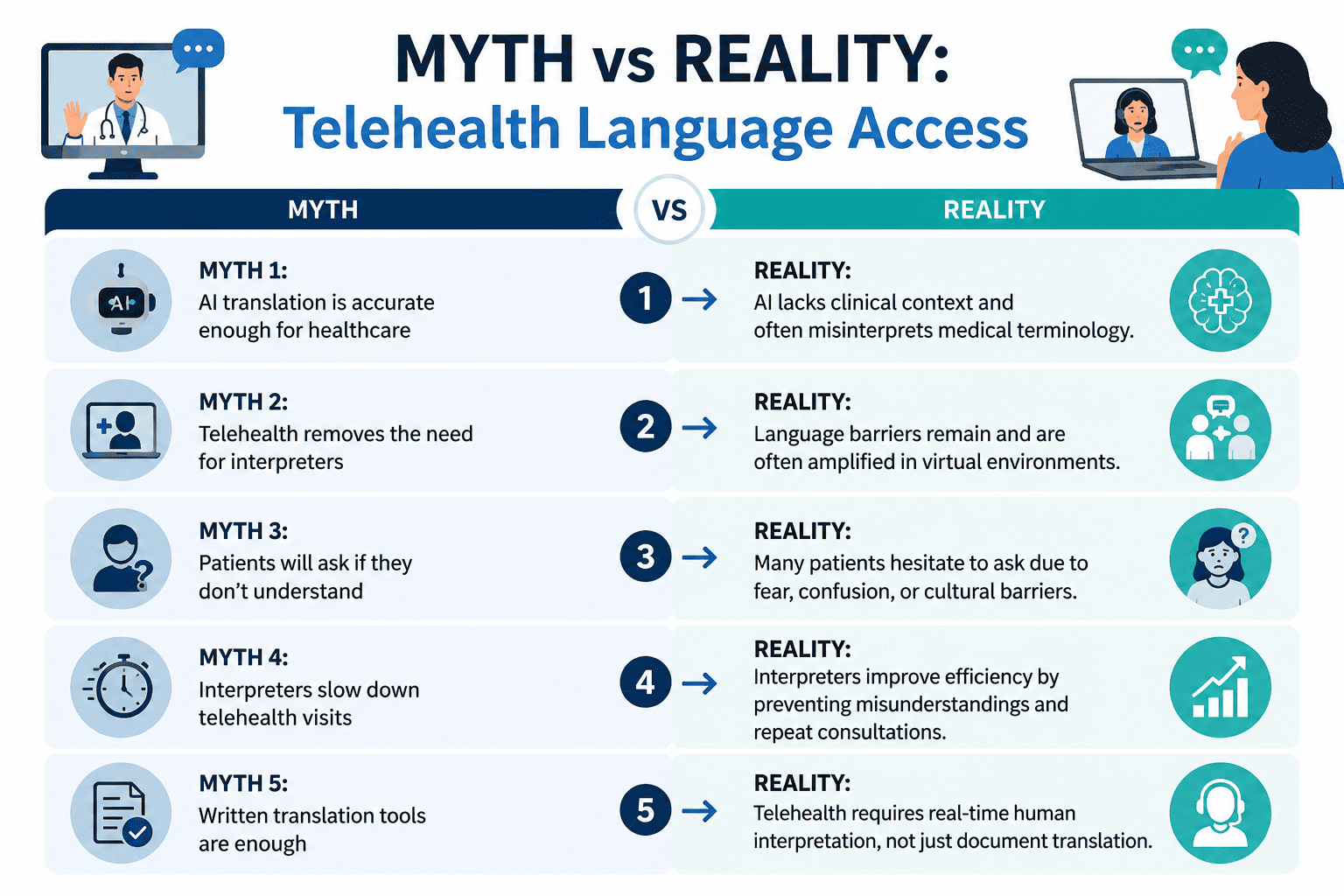
Myth 1: AI translation is accurate enough for healthcare
Reality: AI lacks clinical context and often misinterprets medical terminology.
Myth 2: Telehealth removes the need for interpreters
Reality: Language barriers remain and are often amplified in virtual environments.
Myth 3: Patients will ask if they don’t understand
Reality: Many patients hesitate to ask due to fear, confusion, or cultural barriers.
Myth 4: Interpreters slow down telehealth visits
Reality: Interpreters improve efficiency by preventing misunderstandings and repeat consultations.
Myth 5: Written translation tools are enough
Reality: Telehealth requires real-time human interpretation, not just document translation.
6. Compliance Checklist for Telehealth Language Access
Healthcare providers must ensure that telehealth systems comply with federal language access requirements.
Regulatory Compliance
- Are LEP patients receiving meaningful access under Title VI?
- Are Section 1557 nondiscrimination requirements being followed?
Interpreter Integration
- Are trained medical interpreters available during virtual visits?
- Are interpreters integrated into telehealth workflows?
Technology & Quality Control
- Are video translation services in healthcare validated for clinical use?
- Are AI tools supplemented with human oversight?
Patient Safety
- Is patient understanding verified during consultations?
- Are critical instructions repeated and confirmed?
Ongoing Quality Assurance
- Are telehealth language services regularly audited?
- Are interpreter performance metrics tracked?
7. Why Healthcare Providers Partner with Professional Language Services
Healthcare organizations are increasingly turning to specialized providers because telehealth introduces new communication complexity that technology alone cannot solve.
Partnering with Connected Translations ensures:
- Access to trained medical interpreters
- Integration with telehealth platforms
- Compliance with federal language access laws
- Reduced clinical risk and liability
- Improved patient satisfaction and trust
- Better health outcomes for multilingual populations
In modern healthcare, language access is not just a service—it is a patient safety requirement.

Dominique Gomez is a writer and content strategist with a deep curiosity for how language shapes connection across cultures. With over ten years of experience crafting digital content for global audiences, Dominique brings a thoughtful and practical voice to the Connected Translations blog.