.webp)

Translation Service Cost vs. Translator Fees: What’s the Difference?

Summary
A translation that looks inexpensive today can cost you much more tomorrow if it causes an immigration delay, legal misunderstanding, medical error, or failed business transaction. Translator fees usually cover the linguist’s work, while the total translation service cost may include proofreading, certification, formatting, project management, quality control, and secure delivery. Knowing the difference helps you compare translation prices based on outcomes—not simply the lowest quote.
1. What Is Included in a Translation Service Cost?
When people search for translation costs, they often expect to find one standard price per word or per page. In practice, professional translation pricing is rarely that simple.
A translation service cost reflects the complete process required to turn a source document into an accurate, usable, and properly prepared translation.
The final price may include much more than the time a translator spends converting text from one language into another.
Depending on the project, a professional translation service may include document review, selection of a qualified linguist, terminology research, translation, editing, proofreading, formatting, certification, quality assurance, project management, customer support, revisions, and secure delivery.
Each of these steps serves a specific purpose.
The initial review helps determine the document’s language, complexity, length, condition, and intended use.
Translator selection helps ensure that the professional assigned to the project has the correct language combination and relevant subject-matter experience.
Proofreading and quality control can identify omissions, inconsistent terminology, incorrect numbers, and formatting problems before the client receives the final file.
Formatting may also represent a significant part of the work.
A birth certificate, academic transcript, legal judgment, medical report, or financial statement may contain tables, seals, signatures, handwritten annotations, identification numbers, and information arranged in multiple columns.
Reproducing that structure can make the translation easier to review and compare with the source document.
Certification is another service that may affect the translation price.
For example, USCIS instructs applicants submitting foreign-language documents to include a complete English translation and a translator’s certification confirming that the translation is complete and accurate and that the translator is competent to translate into English.
That requirement means an immigration translation is not necessarily complete when the words have been translated.
The final package may also require a properly prepared certification statement containing the required assurances and translator information.
The same principle applies in other high-stakes environments.
A law firm may need consistent terminology across hundreds of pages of evidence.
A healthcare organization may require translated patient materials that communicate instructions accurately.
A company entering a new market may need contracts, policies, marketing content, and technical documentation localized for a specific audience.
In each case, the buyer is paying for an outcome: a translation that can be understood, reviewed, submitted, published, or used for its intended purpose.
This is why the full translation service cost may be higher than the fee paid directly to one translator.
The price may reflect not only linguistic labor but also the systems, professionals, and safeguards surrounding the work.
Connected Translations helps clients manage this process by evaluating the document, intended use, language requirements, certification needs, and deadline before preparing a quote.
This allows clients to understand what the service includes rather than receiving a vague price that may not account for the project’s actual requirements.
2. How Are Translator Fees and Translation Rates Calculated?
A translator fee is the amount charged by an individual language professional for completing the linguistic portion of a project.
That fee may be calculated per word, per page, per character, per hour, or as a flat project rate.
The appropriate pricing method depends on the type of content, language pair, document format, level of specialization, and amount of work required.
The American Translators Association notes that translation pricing can vary according to the language combination, requested services, complexity, subject matter, deadline, and volume of text.
Per-Word Translation Rates
Per-word pricing is common for documents such as contracts, reports, manuals, website content, product descriptions, and corporate communications.
The translator or translation company determines the number of words in the source document and applies an agreed rate.
For example, the price of a 5,000-word document would be calculated by multiplying the source word count by the applicable per-word rate.
This method provides a relatively predictable price when the source text is clear, complete, and available in an editable format.
However, the language combination can affect the rate.
Frequently requested language pairs may have a larger pool of qualified translators, while less common languages may require more time to source and may command higher fees.
Per-Page Translation Prices
Per-page pricing is frequently used for standardized documents such as birth certificates, marriage certificates, diplomas, academic records, identification documents, and certain immigration forms.
A fixed page rate can make pricing easier for clients because many official documents contain a limited amount of text but still require careful formatting, review, and certification.
The American Translators Association explains that some translators use per-page or flat fees for certificates and diplomas, while per-word pricing is more common for longer documents.
Hourly Translation Fees
Hourly rates may be appropriate when the scope cannot be measured accurately by counting words.
Examples include editing an existing translation, transcribing an audio recording before translating it, reviewing handwritten material, researching specialized terminology, reformatting complex tables, or adapting highly creative marketing copy.
A short document can require several hours of work if it is difficult to read, highly technical, culturally sensitive, or poorly formatted.
Minimum and Flat Project Fees
Many language professionals apply a minimum fee because even a one-page project requires administrative and production work.
The provider must review the file, communicate with the client, prepare the translation, perform quality checks, deliver the document, and manage billing.
The American Translators Association notes that short texts may still require considerable expertise and administrative time, which is why minimum service charges are common.
A flat fee may also be offered when the provider can evaluate the entire project in advance.
This can be useful when several services—such as translation, formatting, certification, and expedited delivery—are included in one package.
3. Translator Fees vs. Translation Company Prices
A freelance translator and a professional translation company may both produce high-quality work. The main difference is often the scope of responsibility each assumes.
An independent translator may personally manage the translation, client communication, invoicing, revisions, and delivery.
This can work well when the project involves one language pair, a manageable volume, and a subject the translator knows well.
A translation company usually coordinates a broader service.
It may assign a project manager, select a specialized translator, arrange independent proofreading, recreate the document’s layout, prepare a certificate of accuracy, and provide customer support after delivery.
A translation company’s price may cover:
- Review of the source material
- Translator selection and availability
- Subject-matter expertise
- Editing and independent proofreading
- Terminology management
- Document formatting
- Certification preparation
- File security and confidentiality procedures
- Deadline monitoring
- Revisions and post-delivery support
- Coordination of multiple languages or large volumes
The client is therefore not necessarily comparing the same product when reviewing a freelancer’s quote and a translation company’s quote.
Suppose a freelance translator quotes $65 for a document while a translation company quotes $110.
The first quote may cover translation only.
The second may include translation, proofreading, document formatting, certification, and customer support.
The higher quote does not automatically represent a larger markup for identical work.
It may reflect a broader service and a more complete deliverable.
At the same time, a translation company is not automatically the correct choice for every situation.
Clients should base their decision on the project’s complexity, deadline, language requirements, consequences of an error, and need for ongoing support.
For a personal letter used only for reference, a qualified freelancer may be sufficient.
For an immigration filing, court submission, medical record, international contract, or multilingual business project, a managed translation service may provide valuable safeguards.
4. How to Compare Translation Prices Accurately
The best way to compare translation prices is to evaluate the complete scope of each quote—not just the final dollar amount.
Before selecting a provider, ask what the quoted price includes and whether the provider has reviewed the actual files.
Real-World Scenario: The “Cheaper” Immigration Translation
Consider an immigration applicant preparing a foreign birth certificate for a USCIS filing.
The applicant receives two quotes.
The first is inexpensive and promises a translated Word document within one day.
The second costs more but includes professional formatting, proofreading, and a signed certificate of translation accuracy.
The applicant selects the cheaper option.
When the translation arrives, part of a handwritten annotation is missing. The applicant’s surname is spelled differently from the passport, and the translator did not include a certification statement.
The applicant cannot confidently submit the document. A second provider must review the source, correct the errors, reformat the translation, and prepare the certification.
The applicant has now paid twice and lost valuable time.
USCIS requires a complete English translation and translator certification for foreign-language evidence submitted with many applications.
An incomplete or improperly prepared translation may therefore prevent the submission from meeting the stated document requirements.
The first translation had a lower upfront price. It did not produce the required outcome.
To avoid this situation, compare the following elements:
- Pricing basis: Is the quote based on words, pages, characters, hours, or a fixed project fee?
- Document scope: Does it include every page, seal, stamp, handwritten entry, attachment, and reverse side?
- Translation purpose: Has the provider been told whether the document is intended for USCIS, a court, a university, a healthcare organization, or business use?
- Quality control: Will someone other than the original translator review the work?
- Certification: Is a signed certificate of translation accuracy included when required?
- Formatting: Will the translated document follow the organization of the source?
- Turnaround time: Does the quote include standard service, urgent service, or an additional rush fee?
- Revisions: Are corrections included if a typographical error is found?
- Delivery: Will the client receive a digital file, printed copy, notarized document, or physical shipment?
- Confidentiality: How will personal, legal, financial, or medical information be handled?
The American Translators Association recommends providing the actual document when requesting a quote so the translator can accurately assess the amount and complexity of the work.
A reliable provider should be able to explain the quote in clear language.
Vague pricing, unexplained add-on fees, or promises made without reviewing the source file should be examined carefully.
5. Myth vs. Reality: Common Assumptions About Translation Costs
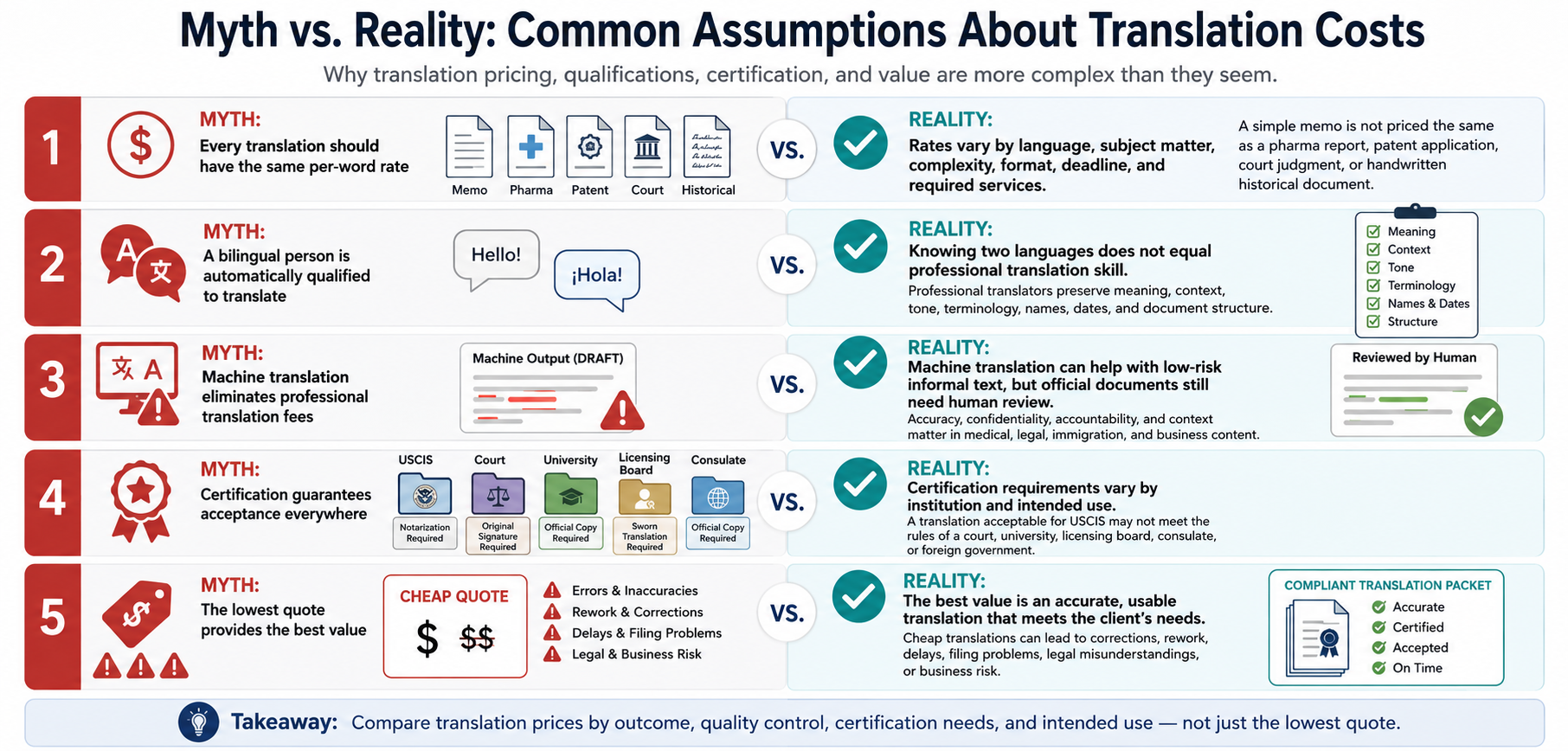
Myth 1: Every Translation Should Have the Same Per-Word Rate
Reality: Translation rates vary according to language, subject matter, complexity, format, deadline, and required services.
A simple employee memo is not equivalent to a pharmaceutical report, patent application, court judgment, or handwritten historical record.
Specialized projects may require extensive terminology research and a translator with relevant professional experience.
Myth 2: A Bilingual Person Is Automatically Qualified to Translate
Reality: Knowing two languages does not automatically provide professional translation skills.
A professional translator must preserve meaning, context, tone, terminology, names, dates, and document structure.
Legal, medical, technical, and financial translations also require familiarity with subject-specific language and conventions.
Myth 3: Machine Translation Eliminates Professional Translation Fees
Reality: Automated tools can be helpful for understanding low-risk, informal text, but they may not provide the accuracy, confidentiality, accountability, or contextual judgment required for official documents.
In healthcare, ineffective communication can contribute to an incorrect diagnosis or delayed or improper treatment, according to the U.S. Department of Health and Human Services.
For legal notices, consent forms, medical materials, immigration evidence, and business contracts, professional human review remains important because errors can have significant consequences.
Myth 4: Certification Guarantees Acceptance Everywhere
Reality: Certification requirements vary by institution and intended use.
A translation that meets USCIS requirements may not automatically meet the rules of a particular court, university, licensing board, consulate, or foreign government.
Some organizations may request notarization, original signatures, sworn translations, or translations completed by specifically authorized professionals.
Clients should verify the receiving institution’s requirements before placing an order.
Myth 5: The Lowest Quote Provides the Best Value
Reality: The lowest quote provides good value only when it delivers an accurate and usable translation that meets the client’s needs.
A low-cost translation that must be corrected or replaced is not economical. The true cost includes additional fees, administrative work, missed deadlines, and the consequences of relying on inaccurate information.
6. Translation Cost and Compliance Checklist
Before ordering a professional translation, confirm the following:
- The provider has reviewed every source document.
- The source and target languages are clearly identified.
- The intended use has been explained.
- All pages, seals, stamps, and annotations are included.
- Names and dates will be checked for consistency.
- The pricing method is clearly stated.
- Proofreading or independent review is included when needed.
- Certification requirements have been confirmed.
- Notarization requirements have been verified separately.
- Formatting expectations are understood.
- Delivery deadlines and rush charges are clear.
- Revision policies are explained.
- Confidential files will be handled securely.
- Printed copies and shipping fees are identified.
- The provider has experience with the relevant subject matter.
This checklist is especially important for immigration applicants, legal professionals, healthcare providers, and companies expanding into new markets.
The U.S. Department of Justice identifies applications, consent forms, notices of rights, benefit documents, and other materials with significant consequences as examples of “vital” documents that may require accurate and timely translation in language-access programs.
For healthcare organizations, qualified translation and interpretation services can also be part of providing meaningful access to patients with limited English proficiency.
Guidance from the U.S. Department of Health and Human Services notes that qualified translators may be used for written documents and online content and that language assistance should be accurate, timely, and protective of patient privacy.
For businesses, the same careful approach can protect contracts, product instructions, employee policies, customer communications, and market-entry materials from avoidable misunderstandings.
7. Why Accurate Translation Pricing Protects the Final Outcome
The purpose of professional translation is not simply to produce text in another language.
It is to create a document that communicates the correct information to the intended reader and performs the function for which it was ordered.
For an immigration applicant, that outcome may be a properly prepared filing package.
For a law firm, it may be evidence that can be reviewed and understood accurately.
For a healthcare provider, it may be information that supports effective communication and informed decision-making.
For a business owner, it may be a contract, technical manual, website, or marketing campaign that can be used confidently in another market.
This is why clients should evaluate translation costs in relation to risk.
When a document has limited consequences, a simple service may be sufficient.
When the document affects immigration status, legal rights, medical care, regulatory compliance, financial obligations, or business reputation, a comprehensive professional service may be the safer investment.
A qualified translation provider should help the client identify these needs before work begins.
The provider should explain how the price is calculated, what services are included, what requirements apply, and what the client will receive.
Connected Translations evaluates each project according to its language pair, document type, intended use, complexity, certification requirements, and delivery deadline.
This approach helps clients choose the appropriate service and avoid paying later for preventable corrections, missing certifications, or unusable translations.
Conclusion
Translator fees and complete translation service costs are related, but they are not interchangeable.
A translator fee usually covers the professional’s linguistic work.
A full-service quote may also include project management, proofreading, quality assurance, formatting, certification, confidentiality safeguards, revisions, and delivery.
The lowest price is not always the least expensive outcome.
An inaccurate, incomplete, or improperly certified translation can lead to additional charges, missed deadlines, filing problems, legal misunderstandings, or business risk.
Before choosing a provider, make sure the quote reflects the complete document, its intended use, and the requirements of the receiving organization.
Submit your documents to Connected Translations for a detailed quote based on the actual files, language pair, certification needs, and delivery deadline.
Choosing the correct translation service from the beginning can help you avoid unnecessary corrections, delays, and rejection.