.webp)

Are You Paying for Translation or Just Replacing Words?
Summary
A low translation rate can look like a smart deal—until a missing sentence, incorrect name, or misunderstood legal term forces you to pay for the work again. Translation costs per word measure volume, but they do not automatically reflect quality, expertise, proofreading, formatting, or compliance. For immigration applicants, attorneys, healthcare providers, and business owners, understanding what is included in the rate can prevent delays, costly corrections, and unusable documents.
1. What Does a Translation Price per Word Actually Buy?
When a translation company quotes a price per word, the calculation may appear straightforward: count the words in the source document, multiply them by the applicable rate, and arrive at the total.
For example, a 4,000-word contract translated at $0.12 per word would have a base translation cost of $480.
That calculation explains the pricing unit. It does not necessarily explain the service.
A professional translation price per word may cover much more than replacing individual words with their closest equivalents in another language. Depending on the provider and the project, the price may include document analysis, translator selection, terminology research, translation, editing, proofreading, quality assurance, formatting, project management, revisions, secure file handling, and final delivery.
This distinction is critical because translation is not a mechanical word-substitution exercise.
Words change meaning according to context. A term that appears simple in everyday communication may have a specific meaning in a contract, medical report, immigration record, technical manual, or financial disclosure. Sentence structure, cultural references, tone, legal conventions, and the intended audience all influence how a qualified translator should communicate the source content.
Consider the English word “execution.” In a business agreement, it may refer to signing a contract. In project management, it may describe implementing a plan. In a legal or criminal context, it can carry a completely different meaning.
A system—or an inexperienced translator—focused only on replacing words may select a technically possible translation that is entirely inappropriate for the document.
The American Translators Association explains that translation pricing is affected by factors such as document format, length, subject matter, language combination, deadline, and the additional work involved. It also notes that scanned and handwritten documents may require more time than editable files.
That means two documents with the same word count may require very different levels of effort.
A clear, editable employee handbook may be relatively straightforward. A handwritten legal record containing stamps, abbreviations, faded sections, and specialized terminology may require extensive review, research, and formatting, even if it contains fewer words.
The per-word calculation should therefore be viewed as a pricing method—not as a complete description of quality.
For decision-makers, the more useful question is not simply, “What is your translation rate per word?”
It is:
“What professional work, review, and accountability are included in that rate?”
Connected Translations evaluates the source files, intended use, language pair, formatting requirements, subject matter, and deadline before preparing a quote. This allows clients to understand the service they are purchasing instead of comparing rates that may represent very different deliverables.
2. Why Translation Costs per Word Vary So Much
There is no universal average translation cost per word that applies equally to every project.
Per-word rates vary because translation projects differ in difficulty, risk, availability, and scope. A common language pair involving general business content may be priced differently from a less common language combination requiring a specialist in pharmaceutical regulation or patent law.
The following factors can influence translation costs per word.
Language Combination
Translation rates depend partly on the availability of qualified professionals for the requested language pair.
A widely requested combination may have a larger pool of experienced translators. A less common language pair may require additional sourcing, specialized recruitment, or coordination across time zones.
Direction also matters. Translating from English into another language is a separate professional skill from translating that language into English. Many translators work primarily into their strongest or native language.
Subject-Matter Complexity
General correspondence usually requires less specialized knowledge than medical research, financial statements, engineering documentation, litigation evidence, or intellectual property materials.
A specialist may charge a higher rate because the project requires knowledge of technical terminology, industry conventions, regulatory language, or legal concepts.
That expertise can reduce the risk of mistranslating terms that affect obligations, safety instructions, diagnoses, or legal rights.
File Format and Document Condition
Editable Word and Excel documents are usually easier to process than scanned PDFs, photographs, handwritten notes, or files containing complex tables.
The ATA advises clients to submit the actual document when requesting a quote because file condition and formatting affect the amount of work required. It also notes that short texts may still be complex and that professional translators commonly apply minimum charges for small assignments.
Deadline
Urgent work may require a higher translation rate per word.
A rush project can require rearranging existing assignments, assigning multiple linguists, working outside normal business hours, or adding an expedited review process.
Additional Services
A base per-word rate may cover translation only. Editing, proofreading, desktop publishing, certification, notarization coordination, printed copies, shipping, or urgent delivery may be separate.
Other providers include some or all of those services in the quoted rate.
This is why comparing two numbers without comparing the scope can be misleading.
A quote of $0.08 per word that excludes proofreading and formatting may ultimately cost more than a $0.12 rate that includes both.
3. Translation or Word Replacement: How to Tell the Difference
A professional translation should communicate the same meaning, purpose, and practical effect as the source document.
Word replacement focuses on individual terms. Professional translation considers the entire message.
Warning signs that a service may be focused primarily on replacing words include:
- The provider gives a quote without reviewing the source document.
- No one asks about the intended use.
- The rate is the same for every subject and language.
- Proofreading is not mentioned.
- Formatting is excluded or ignored.
- The provider cannot explain who will translate the content.
- Names, dates, numbers, and repeated terminology are not checked.
- No revision process is available.
- The provider promises unrealistic delivery times.
- Official document requirements are not discussed.
These signs do not automatically prove that the translation will be poor. However, they suggest that the provider may not be evaluating the elements that affect accuracy and usability.
A qualified translator should understand more than vocabulary. The professional should recognize context, ambiguity, register, terminology, and the expectations of the intended audience.
For example, a marketing slogan may require adaptation rather than literal translation. A legal clause may need to preserve a precise relationship between rights and obligations. A healthcare instruction must remain clear enough for the patient to follow safely.
The U.S. Department of Justice describes translation as producing an equivalent written text in the target language and identifies applications, consent forms, notices of rights, and similar materials as documents that may be vital because of their effect on access to services or benefits.
In those situations, being approximately correct is not enough.
The translation must communicate what the reader needs to understand and act upon.
4. Real-World Scenario: The Lowest Per-Word Rate Costs More
Imagine that a U.S. business is preparing to sign a distribution agreement with a company in Latin America.
The English contract contains 8,000 words. The business receives two translation quotes.
The first provider charges $0.06 per word. The second charges $0.13 per word.
The lower quote would cost $480. The higher quote would cost $1,040.
The purchasing manager chooses the cheaper option because the documents appear to contain the same number of words and both providers promise Spanish translations.
When the translated agreement arrives, the formatting is basic, and no review certificate or explanation of the quality-control process is included. The purchasing manager sends the contract to the foreign distributor.
During negotiations, the distributor challenges several provisions.
A clause describing the distributor’s “exclusive territory” has been translated in a way that suggests exclusivity applies only to a limited sales channel. Another clause incorrectly expresses the period during which either party may terminate the agreement. A warranty limitation uses terminology that is understandable but inconsistent with the rest of the contract.
The company then sends the translation to a specialized legal translator.
The second professional identifies the problems, retranslates key portions, standardizes the terminology, and recommends reviewing the entire agreement because the reliability of the remaining content cannot be confirmed.
The company pays for a second translation, delays contract execution, and creates uncertainty with its new business partner.
The original rate was lower. The total cost was not.
The real financial impact includes:
- The first translation fee
- The cost of legal review
- The cost of corrective translation
- Delayed negotiations
- Additional staff time
- Reduced confidence between the parties
- Potential exposure from relying on inaccurate contractual language
A professional translation service cannot eliminate every business disagreement, but it can reduce preventable linguistic errors by assigning the appropriate expertise, maintaining consistent terminology, reviewing the final text, and clarifying uncertainties before delivery.
This same risk appears in immigration, healthcare, and legal matters.
A mistranslated date on a civil record can create an inconsistency with a passport. An incomplete medical instruction can confuse a patient. A poorly translated consent form may fail to communicate important information. A missing sentence in legal evidence can change how the document is understood.
The lowest translation cost per word should never be treated as the only measure of value when the consequences extend beyond the translation invoice.
5. How Professional Translation Rates Are Built
Professional translators do not set rates simply by guessing what clients may be willing to pay.
A sustainable translation rate reflects the professional’s experience, productivity, operating costs, specialization, taxes, software, research time, administrative responsibilities, and non-billable work.
The ATA explains that U.S. translators commonly use per-word pricing and that a professional may calculate a piece rate by considering an appropriate hourly rate and the number of words that can be translated accurately within that time.
For example, suppose an experienced translator needs to earn approximately $60 per working hour and can responsibly translate 500 words per hour in a particular subject.
Dividing $60 by 500 words produces a base rate of $0.12 per word.
That figure may also need to account for proofreading, research, client communication, revisions, file preparation, and administrative work. A highly technical project may reduce the number of words that can be completed per hour.
Experience can influence productivity as well as price.
An experienced legal translator may charge more per word than a generalist but may recognize terminology, interpret complex clauses, and resolve ambiguities more efficiently. A less experienced translator may charge less initially but require more editing or correction later.
An ATA discussion of pricing notes that an experienced translator may command a higher per-word rate for work that requires little additional editing, while a lower-priced translation may require more back-end work.
For clients, this reinforces an important point:
The rate is only one part of the cost.
A translation requiring extensive correction has a hidden editing cost, even when that cost is not visible in the original quote.
Myth vs. Reality: Translation Costs per Word
Myth: A Lower Per-Word Rate Always Saves Money
Reality: A lower rate saves money only when the translation is accurate, complete, usable, and appropriate for its purpose.
When the work must be reviewed, corrected, reformatted, or replaced, the client may pay more than the cost of hiring the right provider initially.
Myth: Every Translator Should Charge the Same Rate
Reality: Translators differ in experience, specialization, language direction, qualifications, location, workload, and quality-control practices.
A translator specializing in clinical research or international contracts may charge more than a generalist because the work requires specialized knowledge and carries greater risk.
Myth: Per-Word Pricing Includes Everything
Reality: A translation rate per word may cover translation only.
Proofreading, formatting, certification, desktop publishing, notarization, rush service, printed copies, and shipping may be separate. Clients should request a written explanation of what the quote includes.
Myth: Machine Translation Makes Human Translation Too Expensive
Reality: Machine translation may assist with low-risk content or internal understanding, but it does not automatically provide professional accountability, context-sensitive judgment, confidentiality, formatting, or certification.
Technology may be part of a professional workflow, but high-stakes documents still require qualified human review.
Myth: A Short Document Should Cost Almost Nothing
Reality: A one-page document still requires file review, communication, setup, terminology decisions, quality control, delivery, and billing.
The ATA notes that minimum service charges are common because short documents still require professional expertise and administrative time.
Translation Quality and Compliance Checklist
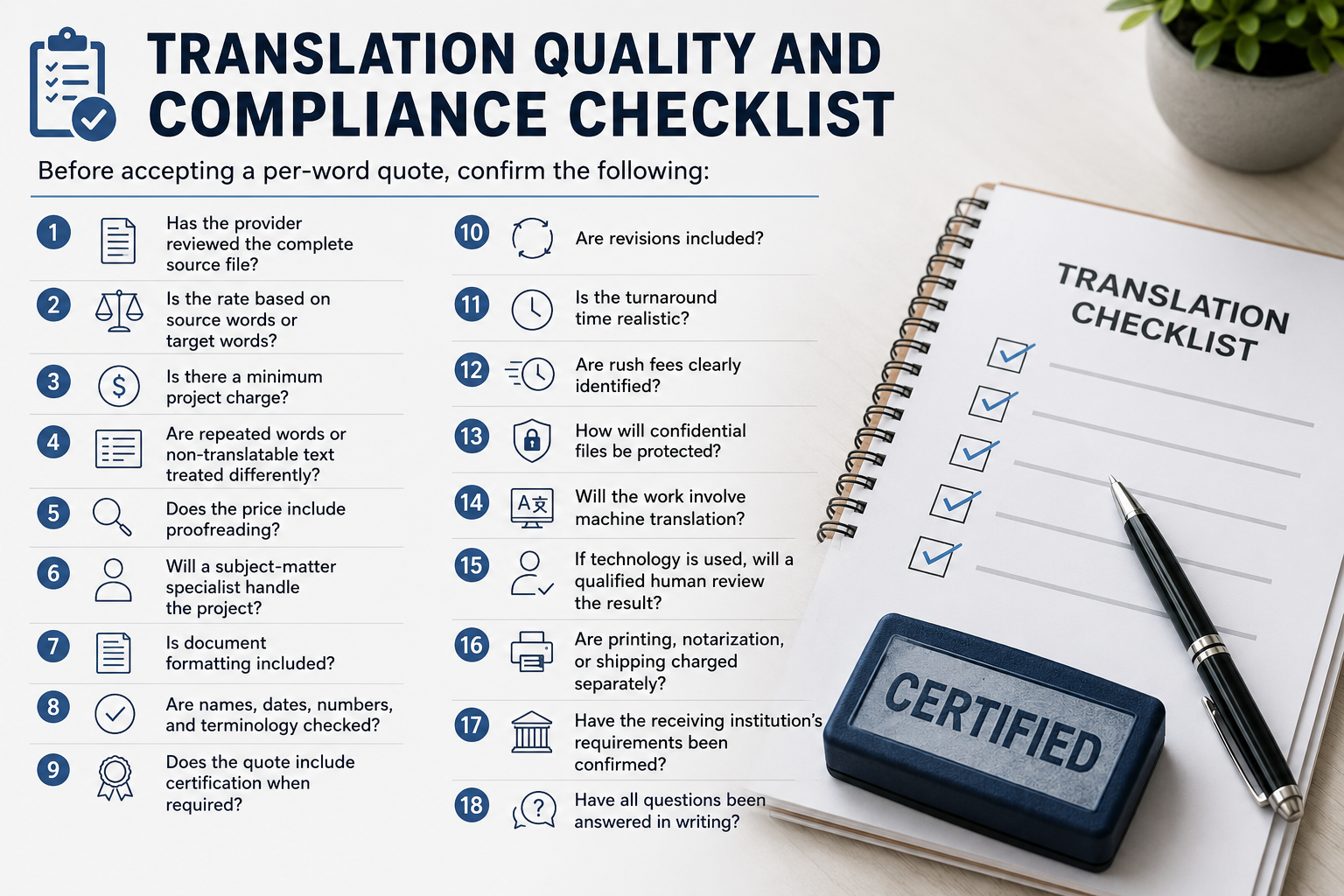
Before accepting a per-word quote, confirm the following:
- Has the provider reviewed the complete source file?
- Is the rate based on source words or target words?
- Is there a minimum project charge?
- Are repeated words or non-translatable text treated differently?
- Does the price include proofreading?
- Will a subject-matter specialist handle the project?
- Is document formatting included?
- Are names, dates, numbers, and terminology checked?
- Does the quote include certification when required?
- Are revisions included?
- Is the turnaround time realistic?
- Are rush fees clearly identified?
- How will confidential files be protected?
- Will the work involve machine translation?
- If technology is used, will a qualified human review the result?
- Are printing, notarization, or shipping charged separately?
- Have the receiving institution’s requirements been confirmed?
USCIS Documents
USCIS states that foreign-language documents submitted with certain immigration applications must include a full English translation and a certification confirming the translation’s completeness and accuracy and the translator’s competence.
For immigration applicants, the quote should clarify whether the certification is included and whether every visible element of the source document will be addressed.
Legal Documents
Legal translations may contain defined terms, cross-references, obligations, jurisdiction-specific concepts, and formatting that affects interpretation.
Law firms and business clients should ask whether the translator has relevant legal experience and whether an independent review is included.
Healthcare Materials
Healthcare translations may involve consent forms, discharge instructions, medication information, patient education, and privacy notices.
These materials should be handled by professionals capable of communicating technical information clearly and consistently. Unclear language may affect patient understanding, informed decision-making, and access to care.
Business Expansion
Companies entering new markets should not evaluate translation solely by the average translation cost per word.
Contracts, websites, packaging, technical manuals, employee policies, and marketing campaigns may require different workflows. Marketing content may need localization, while legal or technical documents may require terminology control and formal review.
6. How to Compare Per-Word Translation Quotes Correctly
To compare quotes fairly, place each provider’s offer within the same framework.
Start with the pricing unit.
Confirm whether the rate is based on source-language words or translated words. Source-word pricing is usually easier to predict because the final count is known before work begins.
Next, identify the included services.
One provider may quote $0.10 per word for translation only. Another may quote $0.14 per word for translation, editing, proofreading, formatting, and project management.
The rates are different because the services are different.
Ask each provider to identify the following:
- The translator’s role: Is the work completed by one translator, a translator and editor, or a larger team?
- Subject expertise: Does the linguist have experience with the document’s industry or intended purpose?
- Quality review: Is the translation reviewed before delivery?
- Formatting: Will headings, tables, labels, and the document’s structure be recreated?
- Technology: Will machine translation or translation memory be used, and how will the output be reviewed?
- Confidentiality: What safeguards apply to the files?
- Certification: Is a certificate of accuracy included when appropriate?
- Revision policy: What happens if the client identifies an error or needs a reasonable correction?
- Deadline: Is the promised turnaround compatible with proper review?
Finally, assess the provider’s communication.
A professional provider should ask questions about the target audience, intended use, terminology preferences, deadlines, and institutional requirements.
A provider that gives an immediate quote without reviewing the document may be assigning a price before understanding the work.
7. What Is the Average Translation Cost per Word?
Clients often ask about the average translation cost per word because they need a budgeting reference.
The difficulty is that an average can hide the factors that matter most.
A rate that is appropriate for general website content in a common language pair may be unsuitable for a handwritten medical report in a less commonly requested language. Legal, technical, financial, medical, and creative content may each require different expertise and production time.
Professional rates can vary widely, and a specific number without context can create false expectations.
Instead of relying only on an industry average, request a quote based on:
- The actual source files
- The source and target languages
- The total word count
- The subject matter
- The intended audience
- The intended use
- The file format
- Required formatting
- Certification needs
- The deadline
- Review requirements
- The delivery format
The most accurate translation cost is not a general online average. It is a quote based on the actual document and the outcome the client needs.
Connected Translations reviews these factors before confirming the price, helping clients understand both the calculation and the final deliverable.
Conclusion
A translation price per word tells you how a provider calculates the invoice. It does not, by itself, tell you whether the final document will be accurate, reviewed, properly formatted, secure, compliant, or suitable for its intended use.
The real difference between translation and word replacement is professional judgment.
A qualified translator considers meaning, context, terminology, tone, audience, and consequences. A professional translation company may add project management, editing, proofreading, formatting, certification, and post-delivery support.
For low-risk content, a basic service may be appropriate. For immigration evidence, legal documents, healthcare materials, technical content, and international business agreements, the cost of an error may be far greater than the difference between two per-word rates.
Before selecting the lowest quote, ask what the rate includes, who will perform the work, how the translation will be reviewed, and whether the final document will meet its intended purpose.
Submit your documents to Connected Translations for a detailed quote based on the actual word count, language pair, subject matter, required services, and deadline. Requesting a document-specific assessment now can help you avoid paying later for corrections, delays, or a translation that cannot be used.

Dominique Gomez is a writer and content strategist with a deep curiosity for how language shapes connection across cultures. With over ten years of experience crafting digital content for global audiences, Dominique brings a thoughtful and practical voice to the Connected Translations blog.