.webp)

Is an ATA Certified Translator Required? Situations Where ATA Certification Really Matters

Summary
ATA certified translators provide accurate, legally compliant translations for immigration, legal, medical, and business documents. Their certification confirms professional expertise, ethical standards, and the ability to handle complex terminology required for official use.
This guide explains what ATA certification means, when it matters, how it protects your documents, and how to find a qualified ATA certified translator for important translation projects.
What Is ATA Certification and Why Does It Matter?
The American Translators Association (ATA) is one of the largest professional translator organizations in the United States.
ATA certification is earned through a rigorous examination process that evaluates a translator’s language proficiency, accuracy, and ability to translate specialized content.
Why ATA certification matters:
- Proven expertise: Certified translators demonstrate advanced translation skills
- Legal and regulatory compliance: Certified translations are often required for official submissions
- Accuracy assurance: Ensures correct interpretation of legal, medical, and technical terminology
- Professional ethics: ATA-certified translators follow strict professional standards
For official or sensitive documents, ATA certification provides additional confidence in translation quality and acceptance.
Key Takeaway: ATA certification confirms professional translation accuracy and reliability.
When Is an ATA Certified Translator Required?
Not every translation requires ATA certification, but there are situations where it becomes extremely important.
Immigration and USCIS Applications
Documents submitted to USCIS often require certified translations.
- Why it matters: Inaccurate translations can delay or jeopardize immigration applications
- Examples: Birth certificates, marriage records, and identity documents
Legal Documents and Court Filings
Legal translations require precise terminology and legally recognized formatting.
- Why it matters: Courts and legal authorities often require certified translations
- Examples: Contracts, affidavits, court orders, and legal evidence
Business and Financial Documents
International business agreements and financial documents require highly accurate translation.
- Why it matters: Translation errors may create legal or financial risks
- Examples: Contracts, financial statements, and compliance documents
Key Takeaway: ATA certified translators are especially important for official, legal, and regulated document types.
How ATA Certification Protects Your Documents
Working with ATA certified translators offers several important protections for official and sensitive documents.
Accuracy and Professionalism
- Certified translators understand industry-specific terminology
- Translations preserve both meaning and legal intent
Legal Compliance
- Certified translations meet official submission requirements
- Reduces the risk of rejection from USCIS, courts, or agencies
Accountability
- ATA-certified translators follow professional ethical standards
- Clients benefit from added credibility and accountability
Choosing ATA certified translation services helps ensure that your documents are accurate, compliant, and professionally handled.
Key Takeaway: ATA certification adds legal credibility, accuracy, and accountability to translated documents.
How to Find an ATA Certified Translator
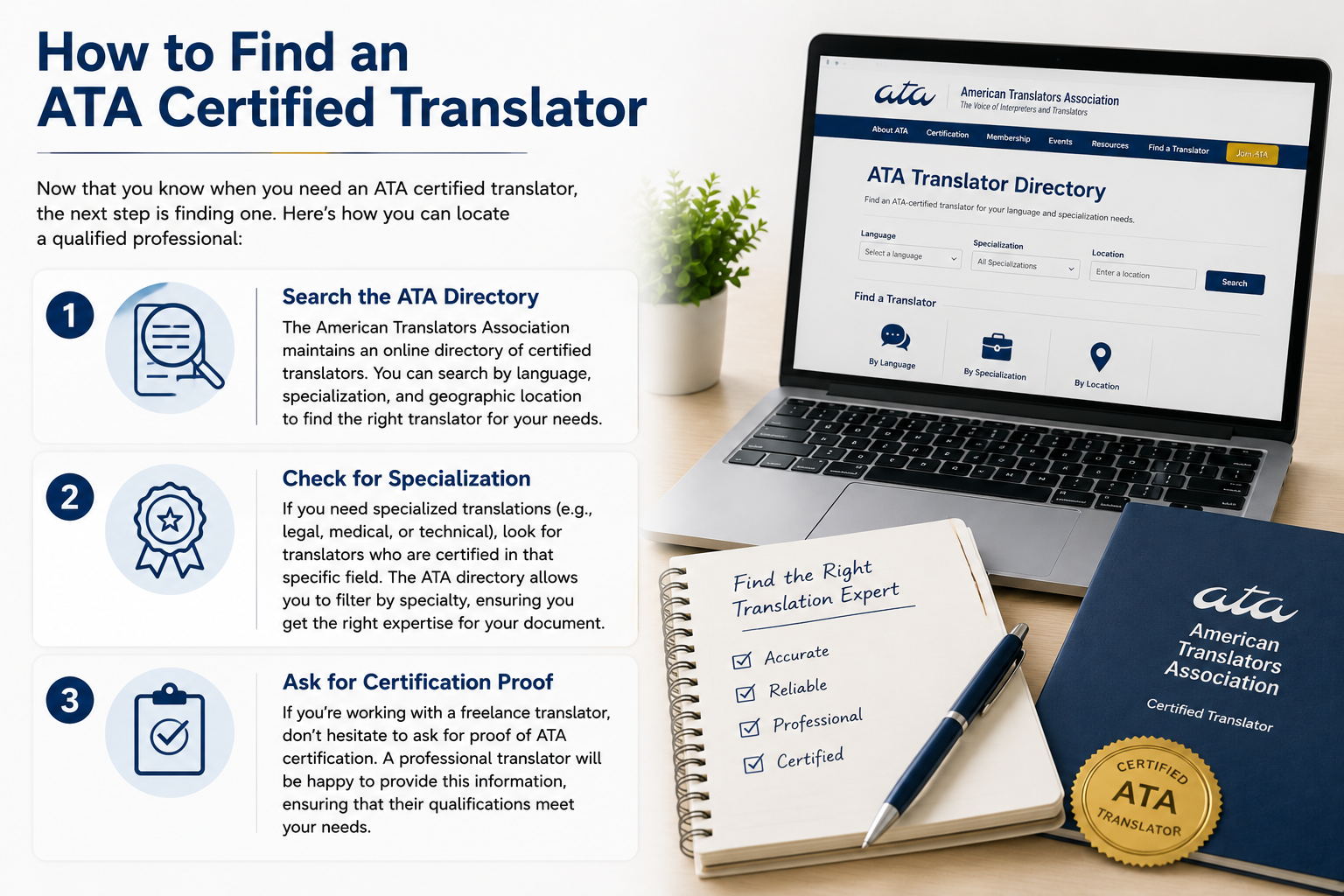
Finding a qualified ATA certified translator is an important step when handling official documents.
1. Use the ATA Directory
The ATA directory allows users to search translators by language pair, specialty, and location.
2. Verify Specialization
Choose translators experienced in legal, medical, technical, or immigration translations when relevant.
3. Request Proof of Certification
Professional translators should be able to provide evidence of ATA certification upon request.
Key Takeaway: Verifying credentials and specialization helps ensure translation quality and compliance.
Conclusion
ATA certification is not always necessary for casual translations, but it is highly important for immigration, legal, medical, and business documents where accuracy and official acceptance matter.
Working with an ATA certified translator helps reduce the risk of errors, delays, or rejected submissions while ensuring that translations meet professional and legal standards.
At Connected Translations, we provide professional ATA certified translation services for immigration, legal, medical, and official document needs.
Key Takeaways
- ATA certification confirms professional translation expertise
- Certified translators are important for legal and immigration documents
- ATA-certified translations improve compliance and acceptance rates
- Professional certified translators help reduce costly translation errors