.webp)

Japanese vs Chinese: Which Language Is Harder to Learn?

Summary
This blog compares Japanese and Chinese by showing where each language is challenging rather than declaring one harder overall. Chinese is more difficult at the start due to tones and character memorization but becomes easier with its simpler grammar. Japanese offers an easier entry with phonetic scripts, but complexity increases later with grammar rules and multiple writing systems. Both languages require long-term commitment, with similar fluency timelines of around 2200 hours. The choice depends on your learning preference, whether you prefer handling early difficulty or gradual complexity. It also clarifies that Mandarin is just one form of Chinese. Ultimately, the better language to learn depends on your goals, such as career, travel, or cultural interest, not just perceived difficulty.
This guide looks at Chinese vs Japanese across writing, grammar, pronunciation, and real learning timelines so you can decide what actually fits your learning style.
Chinese vs Japanese at a Glance
| Feature | Chinese (Mandarin) | Japanese |
| Writing system | Characters only (Hanzi) | Hiragana + Katakana + Kanji |
| Grammar | Relatively simple | More structured, rule-heavy |
| Pronunciation | Tonal (4 tones) | Non-tonal (pitch accent) |
| Difficulty curve | Hard at the start | Easier start, harder later |
| Time to fluency* | ~2200 hours | ~2200 hours |
Based on estimates by the U.S. Foreign Service Institute (FSI), which places both languages in the highest difficulty category for English speakers.
Writing Systems: Where the Real Work Begins
The biggest visible difference in Japanese vs Chinese is writing and it’s where many learners either commit or quit.
Chinese Writing: One System, Thousands of Characters
Chinese uses Hanzi, where each character represents meaning rather than sound. There’s no alphabet to fall back on.
What makes this tricky:
- You need to learn 3,000–4,000 characters for comfortable reading
- Characters don’t directly show pronunciation
- Two systems exist: Simplified (China) and Traditional (Taiwan, Hong Kong)
Even basic reading requires memorization. It’s less about decoding and more about recognition.
That said, once you internalize patterns, reading speeds up. Many characters share components, which helps with recall.
Japanese Writing: Three Systems at Once
Japanese takes a different route and arguably a more layered one.
You’ll deal with:
- Hiragana(basic phonetic script)
- Katakana(used for foreign words)
- Kanji(borrowed Chinese characters)
At first, Hiragana and Katakana feel manageable. You can learn both in a few weeks. That gives a sense of early progress.
Then Kanji enters—and things change.
Challenges here include:
- One Kanji can have multiple readings
- Sentences often mix all three scripts
- Context determines pronunciation
So while Chinese asks for depth in one system, Japanese asks for coordination across three.
- One Kanji can have multiple readings
- Sentences often mix all three scripts
- Context determines pronunciation
So while Chinese asks for depth in one system, Japanese asks for coordination across three.
Grammar: Simple vs Structured
When learners compare Chinese vs Japanese, grammar is where opinions split sharply.
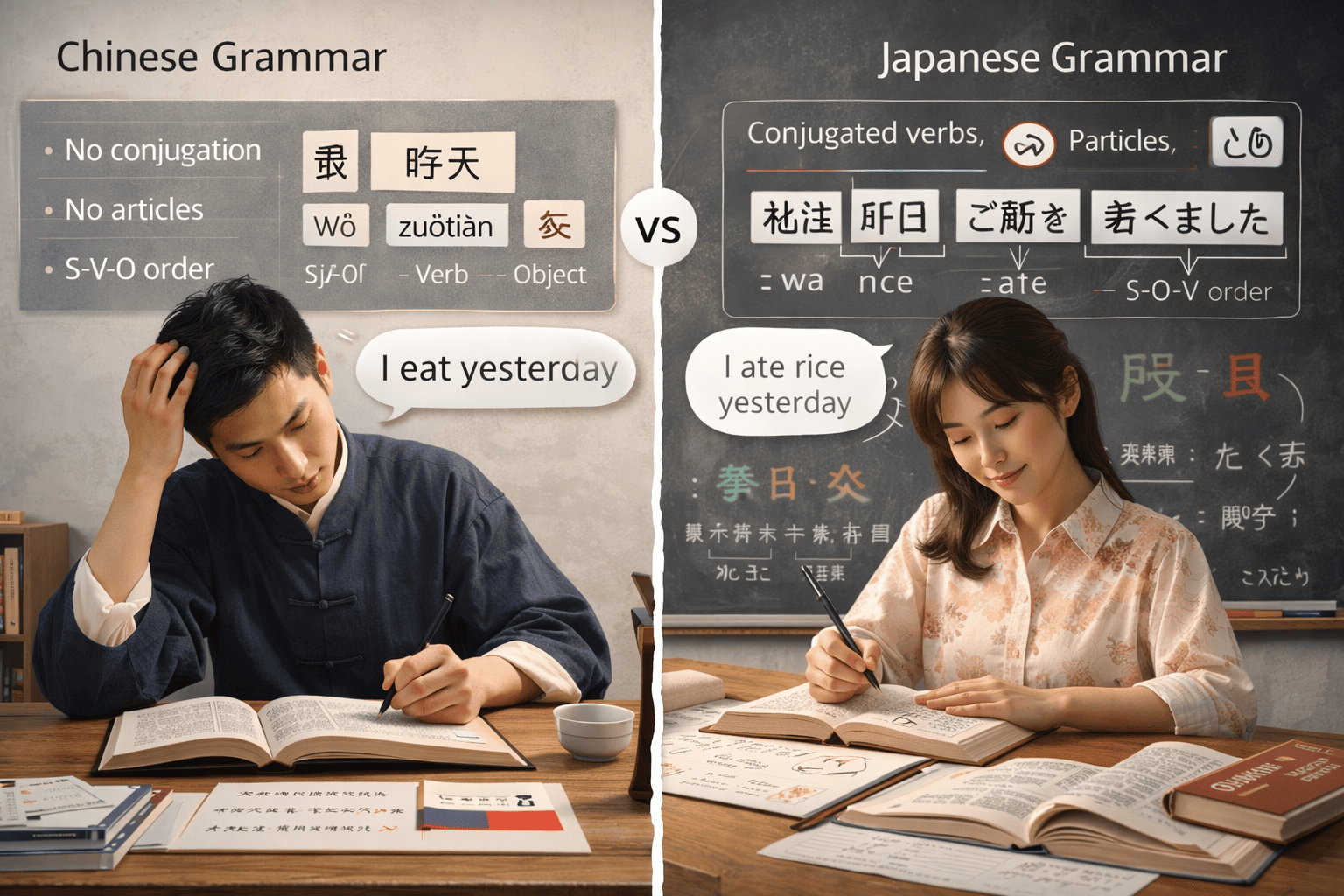
Chinese Grammar: Clean but Context-Heavy
Chinese grammar is often described as “simple,” but that doesn’t mean easy.
Here’s what stands out:
- No verb conjugation (no past/present changes)
- No articles like “a” or “the”
- Word order usually follows Subject–Verb–Object
Example idea:
“I eat yesterday” works structurally; you just add time markers instead of changing verbs.
But there’s a catch: context carries meaning. Without tense markers or articles, learners rely heavily on surrounding words.
Japanese Grammar: Rules, Layers, and Politeness
Japanese grammar feels more familiar in structure—but quickly becomes complex.
Key aspects:
- Verbs change for tense and politeness
- Sentence order is typically Subject–Object–Verb
- Particles define meaning (e.g., “wa,” “ga,” “o”)
A single verb can have multiple forms depending on the situation. Speaking casually with friends is different from speaking in a formal setting.
This system is logical—but it takes time to internalize.
Pronunciation: Tones vs Clarity
If you’ve ever wondered is Japanese hard to learn compared to Chinese, pronunciation is where the difference becomes obvious.
Chinese Pronunciation: Tone Is Everything
Mandarin Chinese uses four tones, and each tone changes meaning.
For example, a syllable like “ma” can mean:
- Mother
- Horse
- Scold
- Question particle
Same spelling, different tone, completely different meaning.
Common challenges:
- Training your ear to hear tone differences
- Producing tones consistently
- Adjusting tones in natural speech (tone sandhi)
This is why many learners find Chinese difficult early on.
Japanese Pronunciation: Easier Entry Point
Japanese pronunciation is more predictable.
- Sounds are consistent
- No tones in the same sense as Chinese
- Based on syllables rather than stress patterns
There is something called pitch accent, but it’s subtle. You can be understood even if you don’t master it perfectly.
So if you’re asking is Japanese hard to learn, pronunciation is usually not the reason—it’s one of the easier parts.
Learning Curve: Where Each Language Tests You
Both languages require long-term commitment, but they “feel” difficult at different stages.
Chinese Learning Curve
- Early stage: Tough (tones + characters)
- Mid stage: Easier (simple grammar helps)
- Advanced stage: Character mastery takes years
Typical progression:
| Stage | Timeline |
| Basic conversation | 1.5–3 years |
| Reading fluency | 4–6 years |
Japanese Learning Curve
- Early stage: Smoother (phonetic scripts help)
- Mid stage: Grammar becomes heavier
- Advanced stage: Kanji and nuance take time
Typical progression:
| Stage | Timeline |
| Basic conversation | 2–3 years |
| Reading & writing fluency | 3–5 years |
Is Chinese and Mandarin the Same?
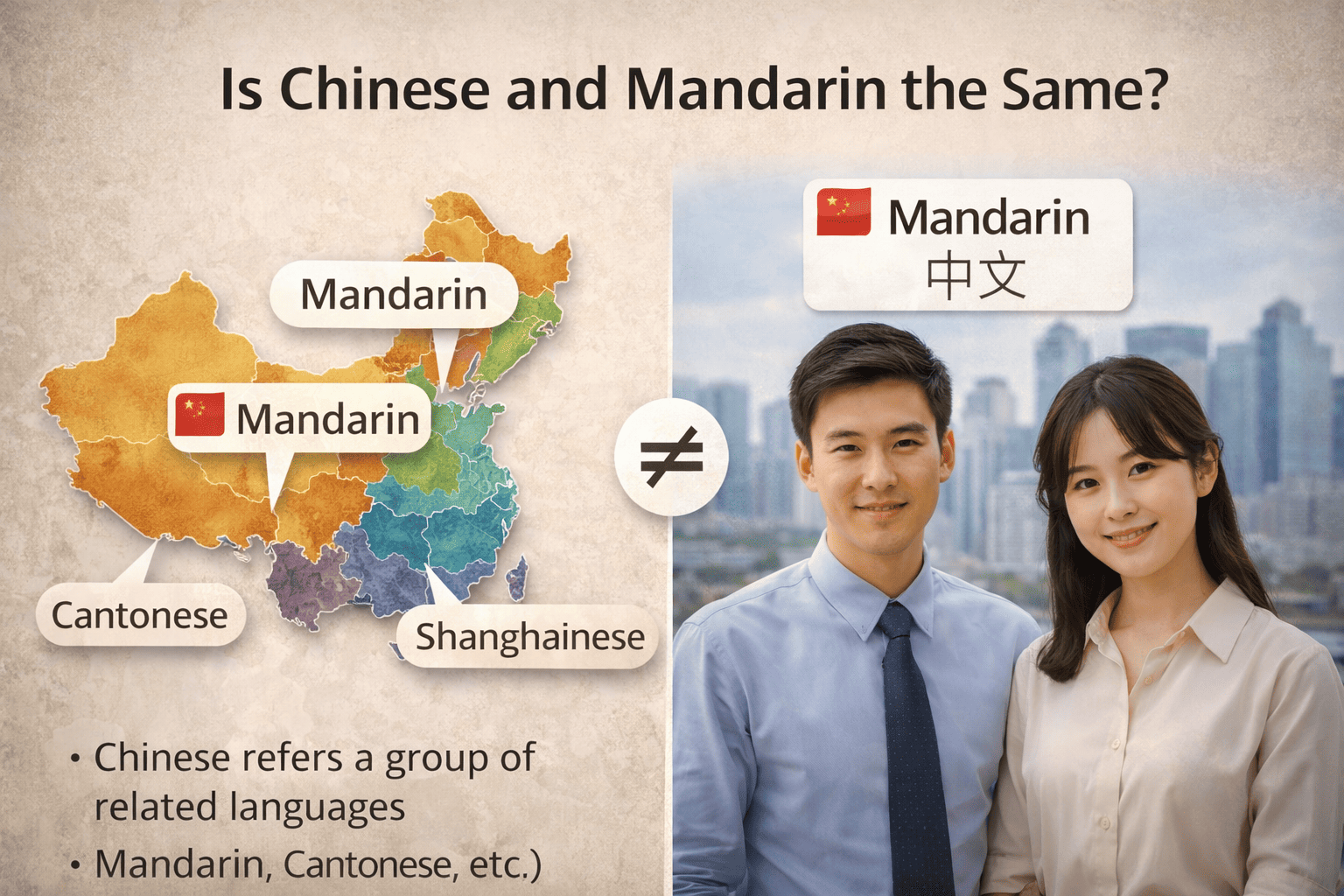
This is one of the most searched questions: are Chinese and Mandarin the same?
Short answer : Not exactly.
Chinese refers to a group of related languages (Mandarin, Cantonese, etc.)
Mandarin is the most widely spoken form
So when people compare Japanese vs Chinese, they usually mean Japanese vs Mandarin Chinese.
Which One Is Actually Harder?
There’s no universal winner, but patterns do show up.
Choose Chinese if you:
- Prefer simpler grammar
- Don’t mind memorization-heavy learning
- Are you okay with tonal pronunciation
Choose Japanese if you:
- Prefer structured rules
- Want a smoother start
- Don’t mind complexity building over time
In practical terms:
- Chinese is harder at the beginning
- Japanese becomes harder as you go deeper
Real-World Use: Does It Matter?
Difficulty isn’t the only factor.
- Mandarin has over 1 billion speakers, making it highly useful globally
- Japanese is concentrated in Japan, but strong in business, tech, and media
Your reason for learning career, travel, culture should weigh just as much as difficulty.
Choosing Between Chinese vs Japanese
The debate around Japanese vs Chinese often looks for a clear winner. In reality, the better question is: Which challenge are you more willing to take on?
Chinese asks you to push through a tough beginning—tones, characters, and memorization. Japanese eases you in, then gradually introduces layers of grammar and writing complexity.
Both demand time. Both reward consistency.
And in today’s global environment, accuracy across languages matters more than ever. Whether it’s business documents or personal communication, services like Connected Translation help ensure nothing gets lost between languages, no matter how complex they are.

Daniel Brooks is a New York City-based writer and content strategist with a deep curiosity for how language shapes connection across cultures. With over ten years of experience crafting digital content for global audiences, Daniel brings a thoughtful and practical voice to the Connected Translations blog.