.webp)

Legal Translations and Their Importance in International Business Transactions

Summary
Official document translation plays a vital role in protecting international business transactions across borders and legal systems. In global commerce, even a minor translation error in contracts, corporate documents, or regulatory filings can lead to disputes, compliance failures, or financial loss. This article explains why businesses must rely on certified translators who understand legal terminology, jurisdictional requirements, and industry standards. It highlights the importance of a certificate of translation accuracy and notarized translations to ensure documents are legally recognized by courts, government agencies, and international partners. From contracts and intellectual property filings to corporate records and tax documents, professional legal translation safeguards clarity and enforceability. By using official document translation services, companies reduce risk, meet global compliance standards, and maintain trust in cross-border business dealings. Accurate legal translation is not just a formality—it is a critical business protection strategy.
1. Why Legal Translation Matters in International Business
International contracts, mergers, and joint ventures often span borders, languages, and legal systems. This complexity makes legal translations essential—not optional. From corporate bylaws to intellectual property rights, precise and accurate translation ensures that all parties understand their rights and obligations.
Imagine this: A U.S. company signs a distribution agreement with a French partner. The original contract is in French. An inaccurate translation omits a crucial termination clause. If a dispute arises, the American company could lose significant legal protection.
Legal documents are written in highly technical language. Misinterpreting a single term could:
- Render a clause invalid
- Create legal loopholes
- Breach regulatory compliance in another country
This is where certified translators come in. A certified translator doesn’t just speak both languages—they understand the legal terminology and context in each jurisdiction.
To give your documents legal standing abroad, you’ll often need:
- A certificate of translation accuracy
- A notarized copy of the translation
- A translation affidavit declaring the translator’s qualifications
All of these help prove your document is an official translation that can be recognized by foreign courts and legal bodies.
2. What Is a Certificate of Translation Accuracy?
A certificate of translation accuracy is a formal statement signed by the translator or agency confirming that the translation is complete and accurate to the best of their knowledge. It often includes:
- The name and qualifications of the translator
- A statement of accuracy
- A description of the document
- A signature and date
This certificate is frequently required in:
- Immigration processes
- Court proceedings
- International business contracts
- Patent filings
When dealing with international business law, a certificate of translation accuracy becomes your legal safety net. It demonstrates to legal authorities, partners, and clients that your documents are trustworthy.
At Connected Translation, every legal translation includes this certificate by default, ensuring your documents meet global compliance standards.
3. Common Documents That Require Legal Translation
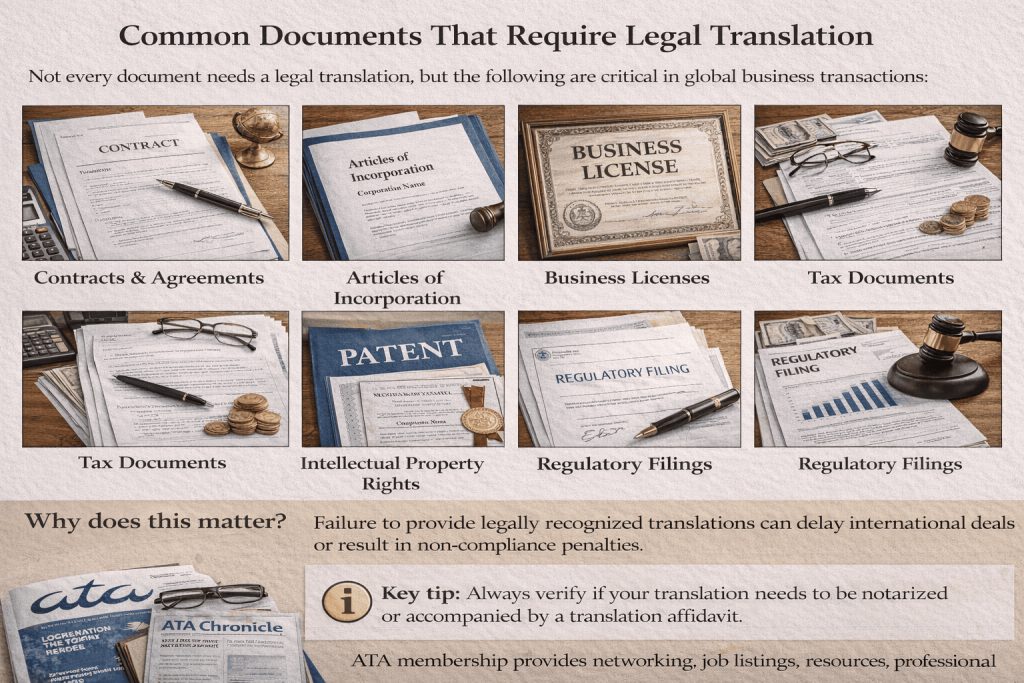
Not every document needs a legal translation, but the following are critical in global business transactions:
- Contracts and agreements
- Articles of incorporation
- Business licenses
- Tax documents
- Intellectual property rights (patents, trademarks)
- Regulatory filings
Why does this matter?
Failure to provide legally recognized translations can delay international deals or result in non-compliance penalties.
Key tip: Always verify if your translation needs to be notarized or accompanied by a translation affidavit.
4. How Certified Translators and Notarized Documents Reduce Risk
Certified translators are often required to translate legal documents because of the high level of liability involved. A mistranslation can lead to court cases, failed deals, or even government fines.
Here’s how certified professionals reduce risk:
- Use standardized legal terminology
- Ensure jurisdictional relevance (laws differ from country to country)
- Work with confidentiality and data security standards
Notarization and affidavits add another layer of protection. A notarized translation includes an official seal and the translator’s sworn statement. This can be especially important in:
- Litigation
- Cross-border disputes
- Regulatory audits
Working with a reputable agency like Connected Translation guarantees all these protections. As a leader in official translation services, we’ve helped thousands of businesses safeguard their interests internationally.

Conclusion
Legal translation is more than just language—it’s about precision, protection, and professionalism. In international business, small errors can have big consequences. By working with a certified translator and securing a certificate of translation accuracy, your company avoids costly mistakes and ensures its documents are respected across borders.
Don’t risk your deal—trust professionals who understand the stakes.