.webp)

Translating Cultural Idioms: Unlocking the Meaning Behind Expressions

Summary
Cultural idioms are expressions whose meanings go beyond the literal definitions of the words used. Translating them accurately requires more than language knowledge; it demands an understanding of cultural context and shared experiences. A direct translation of an idiom can easily confuse readers or change the intended meaning entirely. This is why certified translation services are essential when working with idiomatic language. Professional translators focus on conveying meaning rather than words, often replacing an idiom with an equivalent expression that makes sense in the target culture. Cultural awareness plays a major role, as idioms are shaped by history, traditions, and social norms. Certified translators are trained to recognize these nuances and adapt content without losing tone or intent. Whether translating marketing materials, literature, or official content, accurate handling of idioms helps ensure clarity, cultural respect, and effective communication across languages.
Language is more than just a means of communication; it’s a reflection of a culture’s unique perspective, values, and experiences. One of the best examples of this can be found in idiomatic expressions. These are phrases whose meanings aren’t literal, but instead, carry symbolic or cultural significance. Translating idioms is a fascinating challenge, as it requires not only linguistic expertise but also a deep understanding of the source culture.
Why Idioms Are So Challenging to Translate
Idioms can be puzzling to a translator because their meanings often don’t align with the literal definitions of the words. For instance, the English phrase “it’s raining cats and dogs” doesn’t mean animals are falling from the sky. Instead, it indicates heavy rain. Without proper context, a translator unfamiliar with this phrase might confuse the reader.
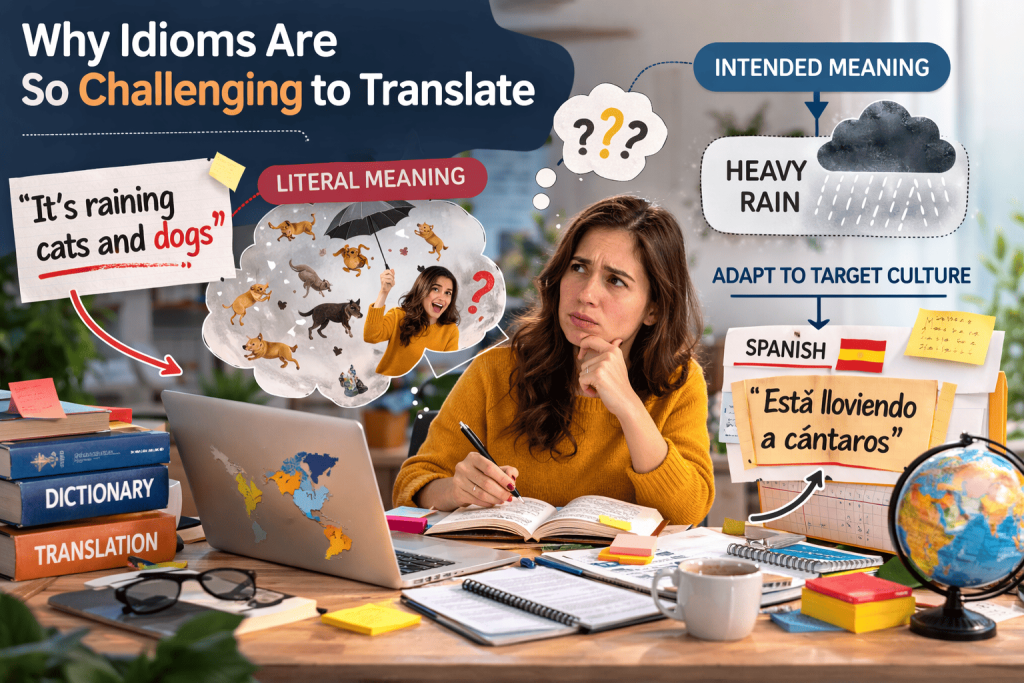
When translating idioms, it’s essential to convey the underlying meaning and adapt the expression to something that makes sense in the target culture. This can often mean replacing the idiom with a completely different phrase that has the same meaning in the target language.
Cultural Context Matters
Culture plays a significant role in shaping idioms. For example, in Spain, a common expression is “estar en la edad del pavo”, which literally translates to “being in the age of the turkey.” However, the idiom refers to the awkward phase of adolescence. In English, we might describe this as the “teenage years” or “awkward age.” Both phrases capture the same cultural phenomenon, but the imagery and expression differ.
Translators need to immerse themselves in the cultural context of both the source and target languages to ensure the intended meaning is preserved. A word-for-word translation can not only be confusing but may also lose the emotional or cultural weight of the original phrase.
The Role of Certified Translation in Translating Idioms
Certified translation companies, such as Connected Translations, play a critical role in providing culturally sensitive and accurate translations. Certified translators are not just proficient in language mechanics, but also trained to understand the intricacies of cultural expressions. This expertise allows them to convey the true meaning behind idioms without distorting the message or confusing the reader.
Conclusion
Translating idioms requires more than just linguistic skills; it demands cultural insight and sensitivity. Certified translation companies like Connected Translations are well-equipped to navigate these complexities, ensuring that idiomatic expressions are translated in a way that preserves their cultural essence and original intent. So, next time you encounter a quirky phrase in another language, remember there’s a rich cultural story waiting to be unlocked.

Daniel Brooks is a New York City-based writer and content strategist with a deep curiosity for how language shapes connection across cultures. With over ten years of experience crafting digital content for global audiences, Daniel brings a thoughtful and practical voice to the Connected Translations blog.