.webp)

Patient Forms, Discharge Instructions, Consent Forms: What Healthcare Documents Need Translation?
Summary
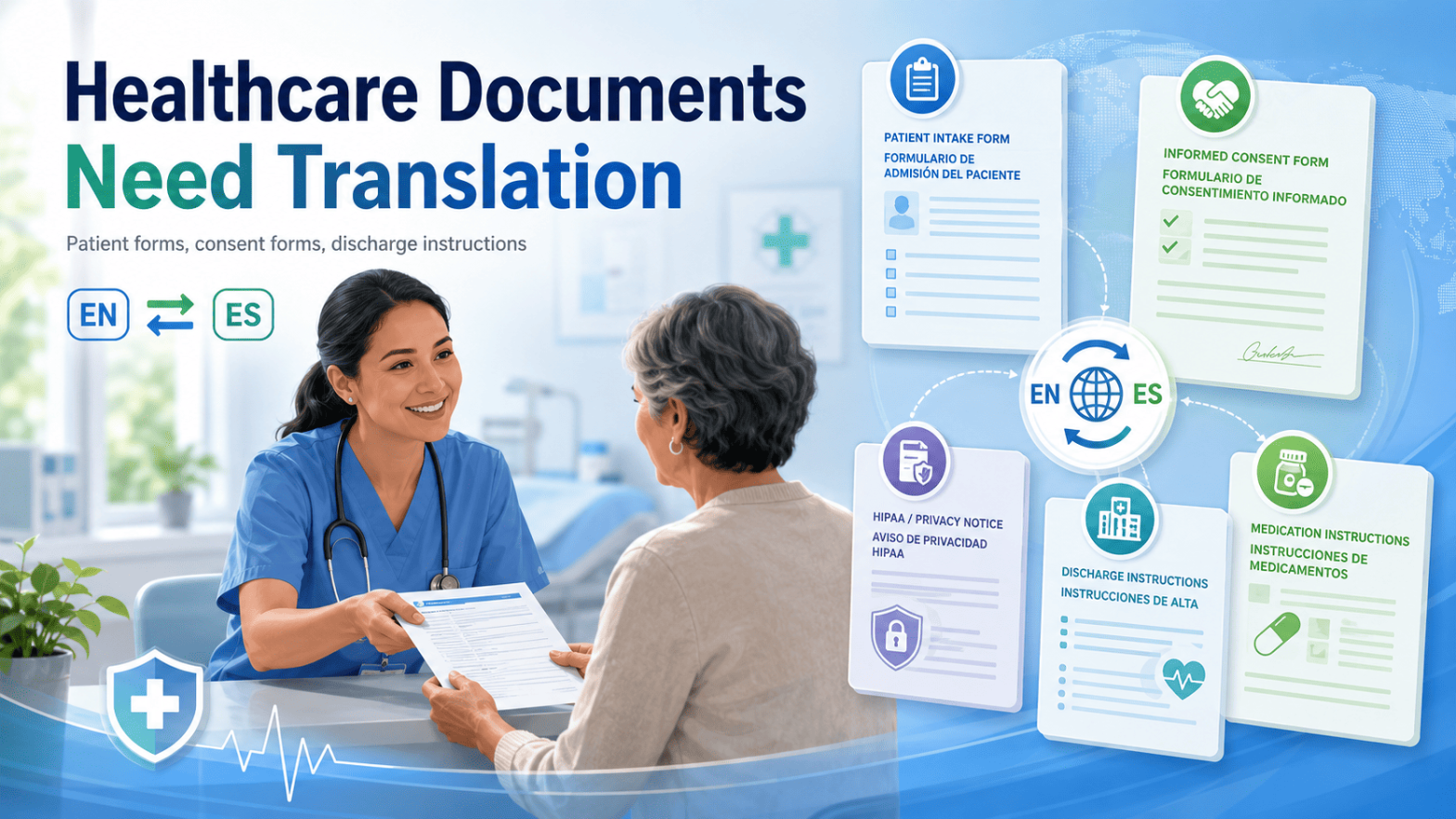
What happens when a patient cannot understand discharge instructions or signs a consent form they cannot read? In the U.S. healthcare system, language access is not optional—it is a legal and clinical requirement. This article explores which healthcare documents require translation, why accuracy matters, how medical interpreter services differ from written translation, and what compliance risks healthcare providers face when communication fails.
1. Why Healthcare Document Translation Is a Patient Safety Issue
A patient misunderstanding a prescription dosage or signing a consent form they cannot fully comprehend is not a minor administrative issue—it is a patient safety failure.
In the United States, healthcare providers are legally required to ensure meaningful access for patients with Limited English Proficiency (LEP). The U.S. Department of Health and Human Services (HHS) makes this requirement clear under Title VI of the Civil Rights Act, which prohibits discrimination based on national origin, including language barriers.
Additionally, the National CLAS Standards require healthcare organizations to provide linguistically appropriate services to ensure patients understand their care instructions and treatment options.
However, compliance is only one part of the issue.
Many healthcare systems assume that having a medical interpreter is sufficient for all communication needs. This is a critical misunderstanding. Interpreters handle spoken communication, but healthcare translation services are responsible for written, legally binding documents that must be accurate, consistent, and clinically precise.
These include:
- Patient intake and registration forms
- Informed consent documents
- Discharge instructions
- Surgical preparation guidelines
- Medication instructions
- Insurance and billing forms
- HIPAA privacy notices
Each of these documents carries clinical, legal, and financial consequences if misunderstood.
Even the Agency for Healthcare Research and Quality has documented how language barriers and low health literacy contribute to medication errors, hospital readmissions, and poor health outcomes.
This raises a critical question for healthcare providers:
Are we truly ensuring patient understanding or just checking a compliance box?
2. Patient Forms, Consent Documents, and Discharge Instructions: What Must Be Translated
Healthcare providers often underestimate how many documents directly influence patient safety and legal protection.
Below are the most critical categories requiring professional healthcare translation services.
2.1 Patient Intake and Registration Forms
Patient intake forms are the first point of contact between healthcare systems and patients. They often include:
- Medical history questionnaires
- Allergy disclosures
- Current medications
- Emergency contact information
- Insurance and billing details
If these documents are not translated accurately, providers risk:
- Missing critical medical conditions
- Incorrect treatment decisions
- Insurance billing errors
- Delays in care
- Life-threatening misunderstandings, such as undetected allergies
A single mistranslated allergy statement can result in severe or even fatal consequences. This is why intake forms must never rely on automated translation tools or informal interpretation.
2.2 Informed Consent Forms (High Legal Risk Documents)
Informed consent documents are among the most sensitive legal materials in healthcare.
They must clearly explain:
- Risks and benefits of procedures
- Alternative treatment options
- Potential complications
- Patient rights and responsibilities
If a patient does not fully understand these elements, the consent may be legally invalid.
Courts and regulatory agencies consistently emphasize that consent must be “informed,” meaning fully understandable in the patient’s preferred language.
This is where professional healthcare translation services are essential—not optional.
A poorly translated consent form can result in:
- Legal liability for providers
- Regulatory penalties
- Ethical violations
- Loss of patient trust
2.3 Discharge Instructions (High Readmission Risk Area)
Discharge instructions are one of the most commonly misunderstood healthcare documents.
They typically include:
- Medication schedules and dosage instructions
- Wound care procedures
- Follow-up appointments
- Warning signs for complications
Studies show that patients with limited English proficiency are significantly more likely to be readmitted when discharge instructions are unclear or improperly translated.
Even a small translation error can change clinical meaning entirely.
For example:
- “Take one tablet every 6 hours as needed” can become
- “Take one tablet only when pain becomes severe”
The difference can lead to under-treatment, worsening conditions, and preventable hospital readmissions.
2.4 Medication Guides and Prescription Labels
Medication errors are among the most dangerous outcomes of poor translation.
These documents must accurately communicate:
- Dosage timing
- Frequency of use
- Drug interactions
- Storage requirements
- Special precautions
The U.S. Food and Drug Administration (FDA) emphasizes clear labeling and patient comprehension as critical components of medication safety, particularly in multilingual populations.
Even minor translation inconsistencies can result in overdose, underdose, or dangerous drug interactions.
2.5 HIPAA Notices and Privacy Policies
Patients must understand how their medical information is collected, stored, and shared.
If HIPAA-related documents are not properly translated:
- Patients may unknowingly consent to privacy terms they do not understand
- Healthcare providers may face compliance risks
- Trust in the healthcare system may decline significantly
These documents are not just administrative—they are legal agreements.
Why Translation vs Interpretation Matters
A medical interpreter supports live conversations such as doctor consultations, emergency triage, or surgical explanations.
However, written healthcare documents require:
- Consistency across all patient materials
- Legal accuracy and enforceability
- Terminology alignment across departments
- Cultural and linguistic clarity
This is why translation is not simply communication—it is regulatory compliance and patient protection.
3. Real-World Scenario: When Translation Failure Becomes a Medical Emergency
Consider a common real-world situation in U.S. hospitals.
A Spanish-speaking patient is discharged after surgery. The hospital uses automated translation instead of certified healthcare translation services.
The discharge instructions state in English:
“Take one tablet every 6 hours as needed for pain.”
However, the translated version incorrectly states:
“Take one tablet only when pain becomes severe.”
At first glance, the difference seems small.
In reality, it causes:
- Inadequate pain management
- Slower recovery
- Increased complications
- Emergency room readmission
The hospital now faces:
- Readmission penalties
- Potential malpractice claims
- Regulatory scrutiny
- Loss of patient trust
This is not a rare scenario—it reflects a systemic risk in healthcare communication when translation is not handled professionally.
With a provider like Connected Translations, healthcare organizations reduce this risk through certified linguistic review, clinical terminology accuracy, and compliance-focused workflows.
4. Myth vs Reality in Healthcare Translation
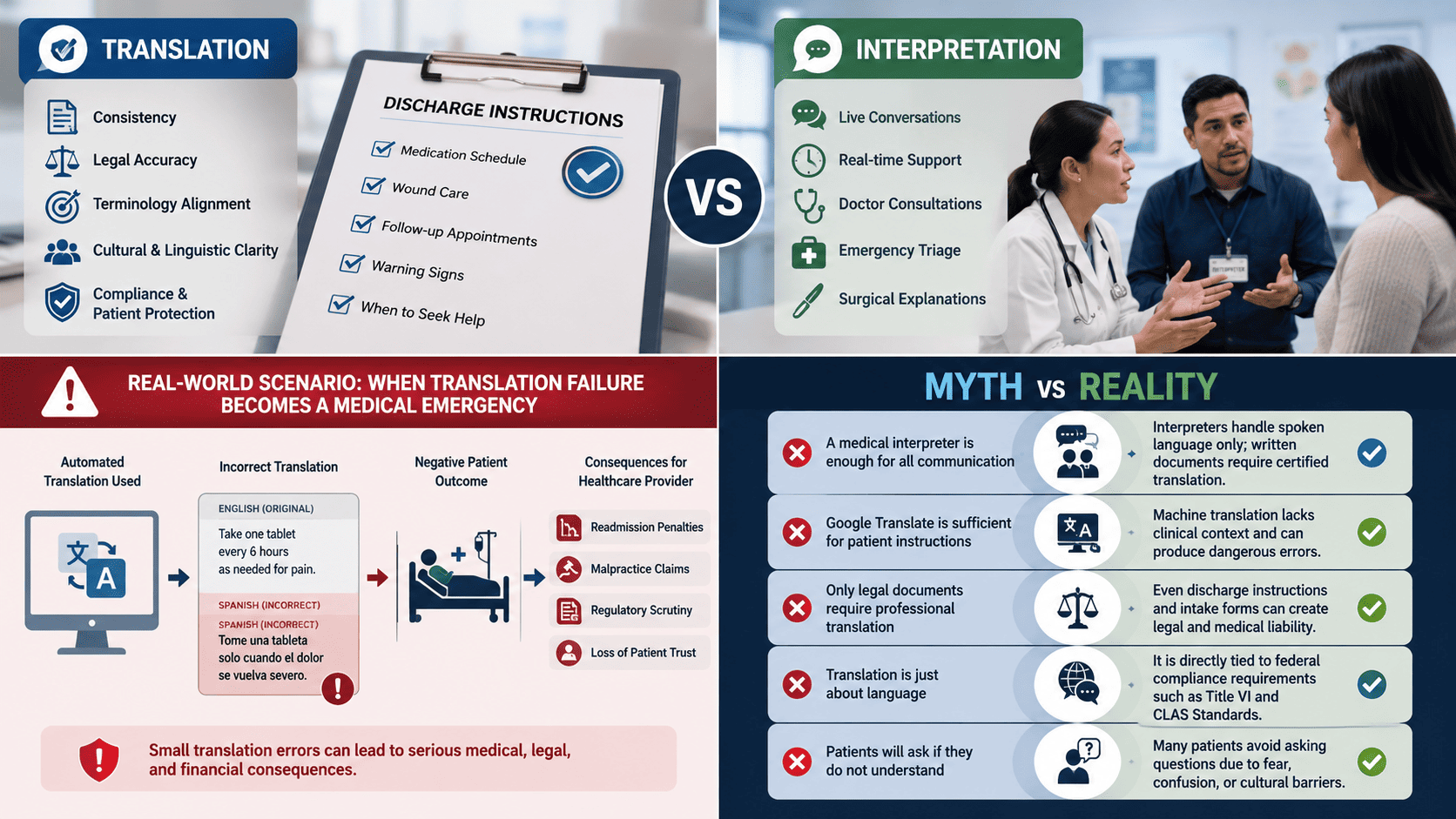
Myth 1: A medical interpreter is enough for all communication
Reality: Interpreters handle spoken language only; written documents require certified translation.
Myth 2: Google Translate is sufficient for patient instructions
Reality: Machine translation lacks clinical context and can produce dangerous errors.
Myth 3: Only legal documents require professional translation
Reality: Even discharge instructions and intake forms can create legal and medical liability.
Myth 4: Translation is just about language
Reality: It is directly tied to federal compliance requirements such as Title VI and CLAS Standards.
Myth 5: Patients will ask if they do not understand
Reality: Many patients avoid asking questions due to fear, confusion, or cultural barriers.
5. Compliance Checklist for Healthcare Translation
Healthcare providers should evaluate their language access strategy using the following checklist:
Regulatory Compliance
- Are LEP patients receiving translated materials under Title VI requirements?
- Are CLAS Standards fully implemented?
Document Coverage
- Are all patient-facing documents translated consistently?
- Are discharge instructions available in key patient languages?
Accuracy & Certification
- Are translations completed by qualified professionals?
- Are medical terms reviewed for clinical accuracy?
Risk Management
- Are consent forms legally valid in the patient’s language?
- Are medication instructions verified for dosage accuracy?
Quality Assurance
- Is there a review and approval workflow for translated materials?
- Are updates synchronized across all language versions?
6. Why Healthcare Providers Choose Professional Translation Partners
Healthcare systems increasingly rely on healthcare translation services because they:
- Reduce medical and legal liability
- Improve patient understanding and outcomes
- Support compliance with federal regulations
- Reduce hospital readmission rates
- Strengthen patient trust and satisfaction
Organizations like Connected Translations provide specialized support for healthcare providers by ensuring every document is handled with:
- Clinical accuracy
- Confidentiality
- Regulatory alignment
- Consistent terminology
- Certified translation standards
This is not just a language service—it is a patient safety system.

Dominique Gomez is a writer and content strategist with a deep curiosity for how language shapes connection across cultures. With over ten years of experience crafting digital content for global audiences, Dominique brings a thoughtful and practical voice to the Connected Translations blog.