.webp)

Finding Harmony in Translation: Navigating the Balance between Machine and Human Translation

Summary
As global communication accelerates, the question isn’t whether to use machine or human translation, it’s how to balance both effectively. This article explores the strengths and limitations of machine translation, from its speed and consistency to its struggles with context and culture. It also explains how human translators add precision, cultural awareness, and quality assurance. By combining AI-driven efficiency with human expertise through post-editing and review, businesses can achieve translations that are fast, accurate, and culturally meaningful.
Nowadays, the demand for translation services has surged to new heights. As businesses expand globally and individuals connect across linguistic borders, the debate over machine translation versus human translation has become more pronounced. Striking the right balance between these two approaches is crucial for effective communication and understanding. In this blog, we explore the strengths and weaknesses of both machine and human translation, and how they can complement each other to achieve better results.
Machine Translation: Speed and Efficiency
Machine translation, powered by advanced algorithms and artificial intelligence, has made significant progress in recent years. Technologies like neural machine translation have improved the accuracy of automated translations, enabling swift and cost-effective solutions. The speed at which machines can process large volumes of text is unparalleled, making them ideal for handling high-volume content in a short period.
Pros of Machine Translation
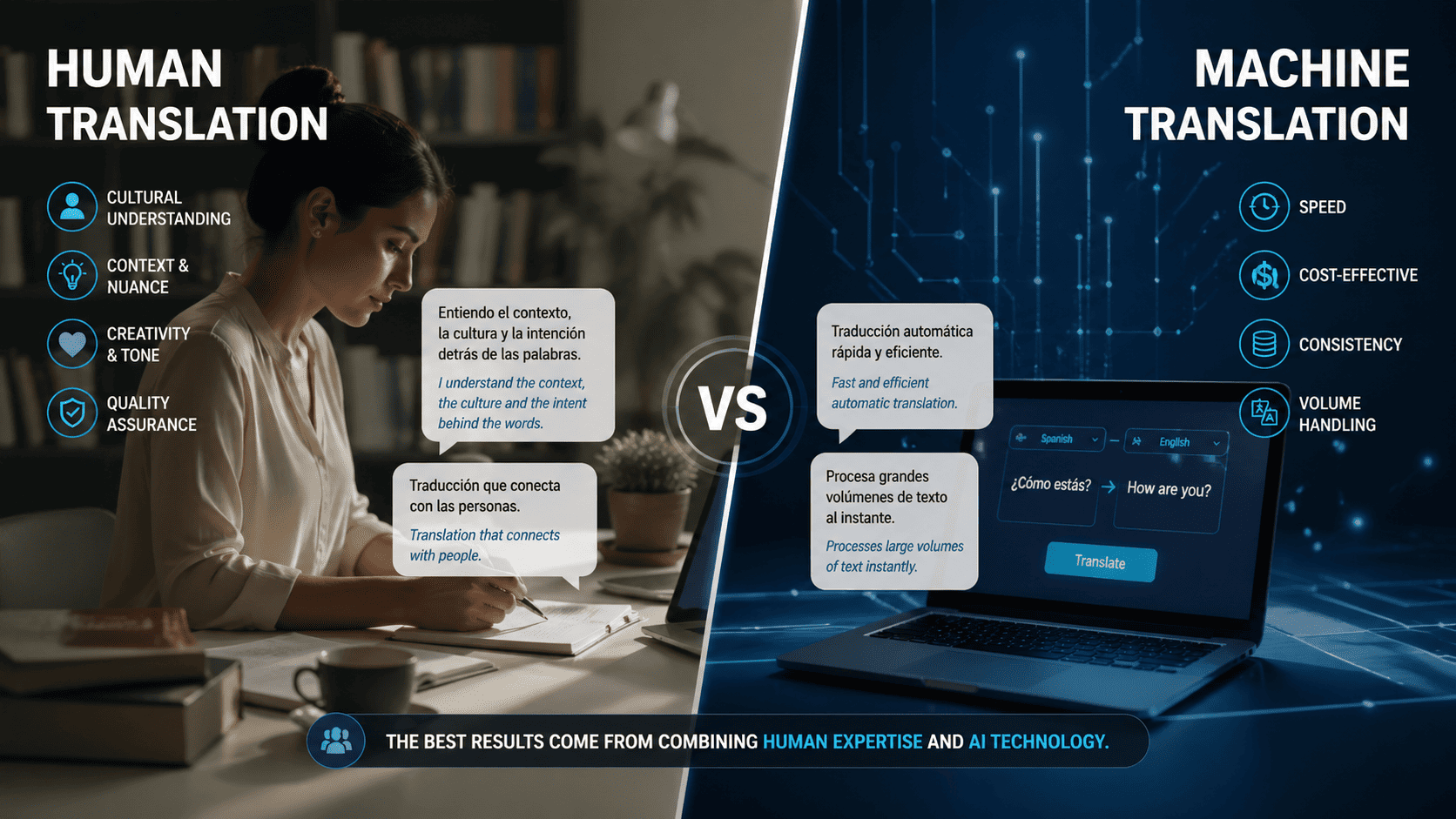
- Speed: Machines can translate content almost instantly, facilitating quick communication in various contexts.
- Cost-Effective: Automated translation is often more economical, especially for large-scale projects with tight budgets.
- Consistency: Machine translation helps maintain consistent tone and terminology throughout a document, reducing the risk of inconsistencies.
Cons of Machine Translation
- Contextual Understanding: Machines may struggle to understand the nuances of language and context, leading to inaccuracies or misinterpretations.
- Cultural Sensitivity: Understanding cultural subtleties is still a challenge for machines, which can result in translations that may feel inappropriate, unclear, or misunderstood.
Human Translation: Precision and Cultural Nuances
While machines excel in speed and efficiency, human translators bring a level of precision and cultural understanding that is hard to replicate. Native speakers with linguistic expertise can navigate the intricacies of language, capture subtle meaning, and ensure that the message resonates with the target audience.
Pros of Human Translation
- Cultural Sensitivity: Human translators understand cultural context, ensuring that translations are appropriate and resonate with the target audience.
- Nuanced Interpretation: Humans can interpret idioms, colloquialisms, and other nuances that machines may struggle to grasp accurately.
- Quality Assurance: Skilled translators provide a level of review and quality control that ensures the final translation meets high standards.
Cons of Human Translation
- Time-Consuming: Human translation is a detailed process, which may not be suitable for projects that require instant turnaround times.
- Cost: Professional human translation services can be more expensive, particularly for large-scale projects.
Striking the Right Balance
The key to effective translation lies in finding the right balance between machine and human capabilities. Businesses do not always need to choose one approach over the other. In many cases, the most effective strategy is to use technology for speed and human expertise for accuracy, cultural relevance, and final quality control.
- Leverage Human Expertise for Precision: Engage human translators for content that requires accuracy, cultural sensitivity, and nuanced interpretation.
- Implement Post-Editing: Combine machine translation with human post-editing to improve accuracy and ensure the final translation meets the desired quality standards.
How Connected Translation Balances Human Expertise and AI
At Connected Translation, we believe in the synergy between human expertise and cutting-edge technology. Our core service centers around human translation, with AI serving as a valuable support system. What sets us apart is our commitment to quality. Every translation undergoes a meticulous 100% human review, ensuring precision, cultural resonance, and accuracy.
While technology plays a crucial role in expediting our delivery process, our emphasis remains on the human touch. Our team of skilled translators brings a depth of linguistic understanding and cultural sensitivity that is indispensable for high-quality translations. We use the speed and efficiency that AI offers to enhance our workflow and meet the demands of today’s fast-paced global communication landscape.
Connected Translation takes pride in delivering not just fast translations, but translations that are certified for accuracy and excellence. We understand that effective communication is not just about words; it is about conveying meaning in a way that resonates with diverse audiences. By integrating human and AI capabilities, we ensure that our clients receive a comprehensive and reliable translation service built on linguistic precision and technological efficiency.

Daniel Brooks is a New York City-based writer and content strategist with a deep curiosity for how language shapes connection across cultures. With over ten years of experience crafting digital content for global audiences, Daniel brings a thoughtful and practical voice to the Connected Translations blog.