.webp)

Birth Certificate Apostille vs Certified Translation: Key Differences

Summary
When preparing a birth certificate for international or legal use, many people get stuck on one question: do you need an apostille, a certified translation, or both? While these processes are often confused, they serve very different purposes. An apostille confirms that your birth certificate is an authentic government-issued document recognized under the Hague Convention. A certified translation ensures the document’s content is accurately translated and legally acceptable to authorities such as USCIS, courts, or foreign agencies. In many real-world scenarios, such as immigration, dual citizenship applications, adoptions, or international legal filings, you may need both. Missing either step can result in document rejection, delays, or repeated submissions. This guide explains the key differences between a birth certificate apostille and a certified translation, when each is required, and how understanding the distinction can save time, prevent costly mistakes, and keep international processes moving forward smoothly.
What Is an Apostille for Birth Certificate?
When it comes to international legal matters, especially immigration, an apostille for a birth certificate is often required. But what exactly is an apostille?
An apostille is an official certification attached to a document to verify its authenticity for international use under the Hague Convention. It authenticates that the document is valid and was issued by an official authority in the country where it was created.
This is important for documents like birth certificates, which may need to be recognized in foreign countries.
Here’s why the apostille matters:
- International Recognition: An apostille ensures that your birth certificate will be accepted by foreign governments or organizations.
- Simplifies Legalization: Instead of going through lengthy embassy or consulate processes, the apostille provides a simple, widely accepted stamp of authenticity.
- No Need for Translation: The apostille verifies the authenticity of your document, but it does not translate the document itself.
For example, if you are applying for a visa or a family-based immigration petition, authorities may require your birth certificate to be apostilled to prove that it is an original, valid document.
Key Takeaway: An apostille ensures that your birth certificate is recognized internationally by validating its authenticity.
What Is Certified Translation?
While an apostille verifies the authenticity of your birth certificate, certified translation focuses on the accuracy of the content.
A certified translation is a translation completed by a qualified translator and accompanied by a signed statement confirming that the translation is accurate and complete.
Here’s what makes a certified translation different:
- Accuracy: Certified translations must be exact, including every word, detail, and format.
- Certification: The translator or translation service certifies that the translation is a true representation of the original document.
- Required for USCIS: USCIS and other legal bodies often require certified translations for foreign-language documents such as birth certificates, marriage certificates, or academic records.
Why is it important?
If you are submitting your birth certificate as part of an immigration petition and it is in a language other than English, you will need a certified translation to ensure the accuracy of your submission. Failure to provide one could result in delays, rejections, or repeated requests for documentation.
Key Takeaway: Certified translations ensure that foreign-language documents are accurately converted into English and meet official requirements.
Key Differences Between Apostille and Certified Translation
Now that we have defined what an apostille and a certified translation are, here is how they differ:
| Aspect | Apostille | Certified Translation |
| Purpose | Validates the authenticity of a document for international use | Ensures the accuracy of a document’s translation |
| Use | Required for international legalization of documents | Required when submitting foreign-language documents to authorities such as USCIS |
| Legal Process | Applied by the competent authority in the country of origin | Performed by a qualified translator or translation agency |
| Documents | Birth certificates, legal documents, and other official records | Birth certificates, marriage certificates, diplomas, and other foreign-language documents |
| Need for Translation | No translation needed; only authenticity is verified | Translation is required when the document is not in English |
In many international procedures, you may need both an apostille and a certified translation. The apostille confirms the validity of your birth certificate, while the certified translation ensures that the document is accurately conveyed into English.
Key Takeaway: Apostille and certified translation serve different purposes but are often required together for international or legal documentation.
Why You Need Both for International Use
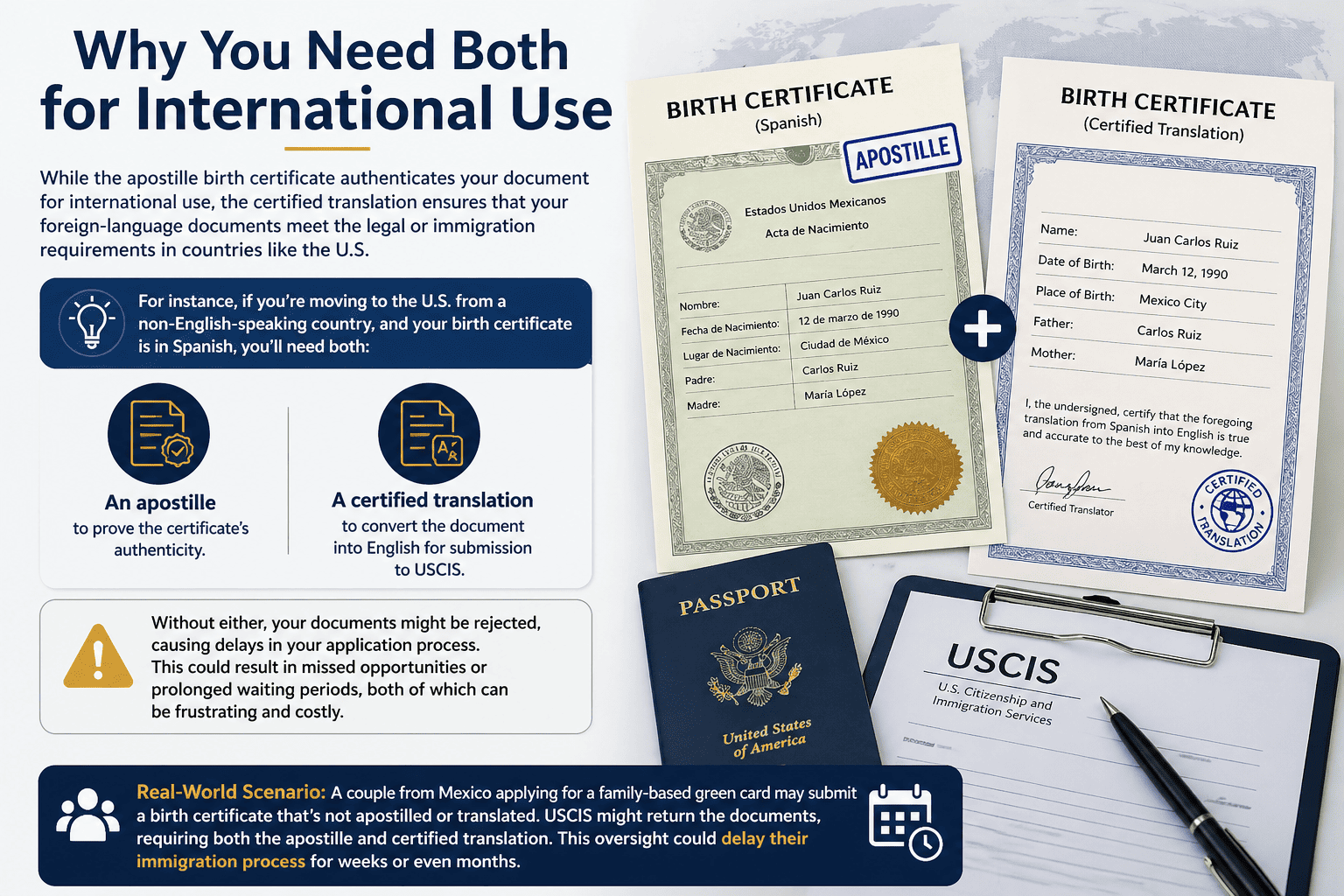
While the apostille birth certificate authenticates your document for international use, the certified translation ensures that foreign-language documents meet legal or immigration requirements in countries like the U.S.
For instance, if you are moving to the U.S. from a non-English-speaking country and your birth certificate is in Spanish, you may need both:
- An apostille to prove the certificate’s authenticity
- A certified translation to convert the document into English for submission to USCIS
Without either, your documents may be rejected, causing delays in your application process. This can lead to missed deadlines, repeated submissions, and additional costs.
Real-World Scenario: A couple from Mexico applying for a family-based green card may submit a birth certificate that is not apostilled or translated. USCIS may return the documents and request both the apostille and certified translation. This oversight could delay the immigration process for weeks or even months.
Key Takeaway: In some situations, both an apostille and a certified translation are required to meet international and legal requirements.
Common Mistakes and How to Avoid Them
Here are some common mistakes people make when dealing with birth certificate apostilles and certified translations:
- Forgetting the Apostille: Many applicants assume that a notarized document is enough for international use. In many cases, an apostille is still required.
- Using Non-Certified Translators: A non-certified translation can lead to inaccuracies in legal documents, which may result in delays or denials.
- Missing the Translation Certification Statement: Always make sure the translator provides a certification statement confirming that the translation is accurate and complete.
How to avoid these mistakes:
- Work with a reputable service that handles both apostille services and certified translations.
- Double-check USCIS or legal requirements before submitting your documents.
- Always use professional translators who are experienced in handling legal documents.
Key Takeaway: Avoid delays and rejections by ensuring both apostille and certified translation requirements are correctly handled.
Conclusion
Both the birth certificate apostille and certified translations play important roles in international and legal processes. The apostille confirms your document’s authenticity, while the certified translation confirms that its content is accurately translated.
Whether you are applying for immigration, handling legal proceedings, or preparing documents for international use, getting both steps right can save time, reduce delays, and prevent document rejection.
Key Takeaways
- Apostilles authenticate documents for international use, while certified translations ensure content accuracy.
- Both apostilles and certified translations may be required for USCIS and legal submissions.
- Missing either step can lead to delays, rejections, or repeated submissions.
- Working with experienced professionals helps ensure your documents are properly apostilled and translated.