.webp)

What Is a Marriage Certificate Apostille and Why It Matters for International Use

Summary
If you plan to use your marriage certificate outside your home country, an apostille is often the missing step that determines whether your document is accepted or rejected. This guide explains what a marriage certificate apostille is, how it authenticates your document under the Hague Convention, and why foreign governments rely on it for immigration, legal, and business purposes. It also outlines when an apostille is required, how to obtain one correctly, and which common mistakes can cause delays.
1. What is a Marriage Certificate Apostille?
A marriage certificate apostille is an official certification that authenticates a marriage certificate for international use. In simple terms, it is a stamp or certificate that verifies the legitimacy of the marriage certificate when it is presented to foreign authorities.
This process ensures that the document can be recognized by countries outside the country where it was issued. It is especially important for immigration, legal, financial, and personal matters that involve foreign government offices or institutions.
The Apostille Process Explained
An apostille is issued by a designated authority in the country where the document originates. In the U.S., for example, each state’s Secretary of State office usually handles apostille requests for marriage certificates.
The apostille verifies that the marriage certificate is an authentic document, signed and sealed by the appropriate authorities. This stamp is then recognized by other countries that are signatories to the Hague Convention of 1961, which established the apostille as a standard form of authentication.
Apostille vs. Embassy Legalization
While an apostille simplifies the process of document authentication, some countries may require embassy or consulate legalization instead.
The apostille is sufficient for countries that have signed the Hague Convention. Other nations may still request further verification. Understanding whether you need an apostille or embassy legalization depends on the destination country’s requirements.
Why You Need an Apostille for Your Marriage Certificate
An apostille is required to prove the authenticity of your marriage certificate in foreign countries. Without it, authorities in the destination country may not recognize the document, which can cause delays in immigration processes, legal matters, or business transactions.
Whether you are applying for a visa, dealing with inheritance, or formalizing an international business agreement, the apostille helps ensure that your marriage certificate is accepted internationally.
2. When Do You Need a Marriage Certificate Apostille?
There are several situations in which you may be asked to provide a marriage certificate apostille. Knowing when to request an apostille can save time and ensure that your documents are ready for international use.
- Immigration and visa applications: If you are applying for a spousal visa, green card, or citizenship in a country other than where you were married, immigration authorities may request an apostille for your marriage certificate.
- Foreign legal proceedings: If you are involved in divorce, inheritance, or property disputes in another country, you may need to submit an apostilled marriage certificate so foreign legal authorities recognize it as valid.
- Adoption processes: For international adoption, countries may require an apostille to verify that the marriage of adoptive parents is legitimate.
- International business and financial transactions: Some international transactions require proof of marital status, especially when setting up businesses, transferring assets, or entering into contracts across borders.
- Recognition of marriage in foreign countries: In some countries, you may need an apostille to have your marriage legally recognized. For example, a marriage performed in the U.S. may need an apostille to be recognized in a European country.
3. How to Get an Apostille for Your Marriage Certificate
Obtaining an apostille for your marriage certificate is usually straightforward, but it requires attention to detail. Each authority may have its own forms, fees, and submission rules, so it is important to follow the correct process from the start.
- Obtain your marriage certificate: Before you can request an apostille, you must first acquire a certified copy of your marriage certificate from the issuing authority. This could be a state or national government office, depending on where the marriage took place.
- Verify apostille requirements for your country: Each country has its own designated authority for issuing apostilles. In the U.S., the Secretary of State in the state where the marriage certificate was issued typically handles apostille requests.
- Submit the marriage certificate for apostille: Submit your original or certified marriage certificate to the appropriate authority along with any required forms and fees. Some authorities allow online applications, while others require in-person or mail submissions.
- Receive your apostille: Once processed, you will receive an apostille attached to your marriage certificate. This usually involves a stamp or official certificate that verifies the authenticity of the document for international use.
- Check for any additional documentation: Depending on where you are using the marriage certificate, additional documents may be required, such as a notarized affidavit or legal translation.
4. Common Mistakes to Avoid When Requesting a Marriage Certificate Apostille
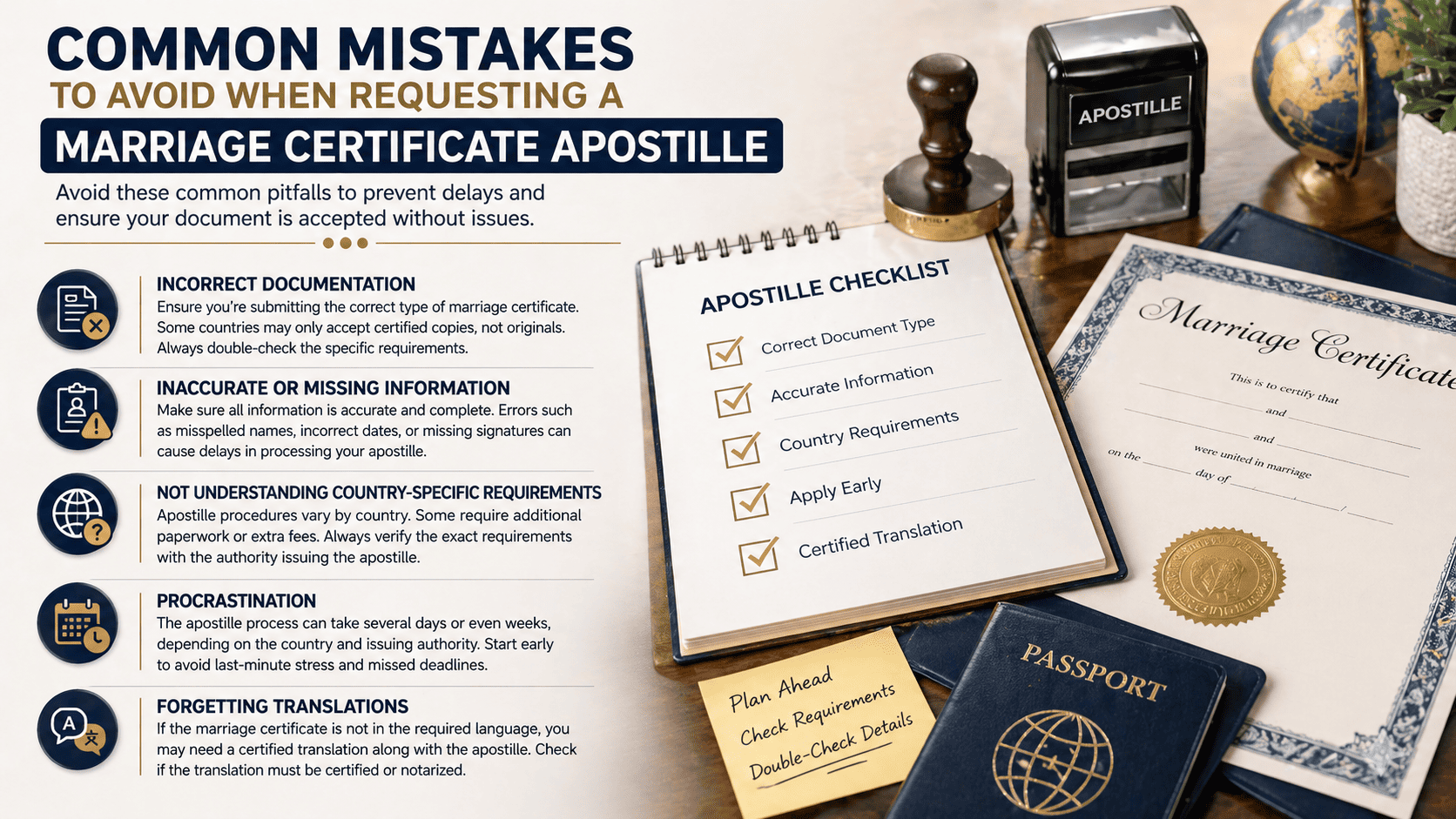
When applying for a marriage certificate apostille, several common mistakes can delay the process or create complications. Avoiding these issues can help ensure your document is accepted without unnecessary back-and-forth.
- Submitting incorrect documentation: Make sure you are submitting the correct type of marriage certificate. Some countries may only accept certified copies, not originals.
- Providing inaccurate or missing information: Check that all information on your marriage certificate is accurate and complete. Misspelled names, incorrect dates, or missing signatures can delay processing.
- Ignoring country-specific requirements: Apostille procedures vary by country. Some authorities may require additional paperwork, specific forms, or extra fees.
- Waiting until the last minute: The apostille process can take several days or even weeks, depending on the country and issuing authority. Start early to avoid deadline issues.
- Forgetting translations: If the marriage certificate is not in the language required by the destination country, you may also need a certified translation along with the apostille.
Conclusion
A marriage certificate apostille is a vital document for international use, especially when dealing with immigration, legal proceedings, or international business. It ensures that your marriage certificate is recognized by foreign authorities and provides an additional layer of authenticity to the document.
The process of obtaining an apostille is relatively straightforward, but it is important to avoid common mistakes, such as submitting incorrect documents or failing to meet country-specific requirements. With careful preparation and the right guidance, you can ensure that your marriage certificate is properly authenticated and ready for use across borders.