.webp)

What Is the Oldest Language in the World? History and Surprising Facts

Summary
The oldest language in the world is not easy to define, since spoken language existed long before writing. However, when historians refer to the “oldest language,” they usually mean the earliest language with a written record. By that definition, Sumerian is widely considered the oldest known written language. It emerged in ancient Mesopotamia around 3000 BCE and was recorded using cuneiform on clay tablets.
That said, Sumerian was not the first spoken language—humans likely communicated verbally tens of thousands of years earlier through oral proto-languages that left no written trace. Other ancient languages also play an important role in linguistic history. Tamil, for example, is often cited as the oldest living language, with written records dating back over 2,000 years and continuous use today. Egyptian, Sanskrit, and Akkadian further show how early languages shaped communication, culture, and civilization over time.
Ask ten people what is the oldest language in the world is, and you’ll likely hear the same answer repeated. But the topic isn’t that neat. The confusion usually comes from one thing: we’re trying to pin a single label on something that evolved gradually.
Languages don’t begin on a fixed date. They shift, split, and rebuild over time. So when we talk about the oldest language in the world, we’re really choosing a definition, and that choice changes the answer.
What Do We Mean by “Oldest”?
Before naming any language, it helps to narrow the lens. Historians and linguists usually work with three practical ideas:
| Category | Meaning | What We Can Actually Prove |
| Oldest written language | First recorded in a script | Yes |
| Oldest language still spoken | Still used today | Yes |
| First spoken language | Earliest human speech | No clear proof |
That last one is where most assumptions fall apart. Humans spoke their first words before written language became available. The absence of records prevents any possibility of verifying the appearance and sound of early languages.
The oldest language in the world exists in most discussions as the answer because it refers to the earliest known language that has documented evidence.
Sumerian: The Earliest Written Record
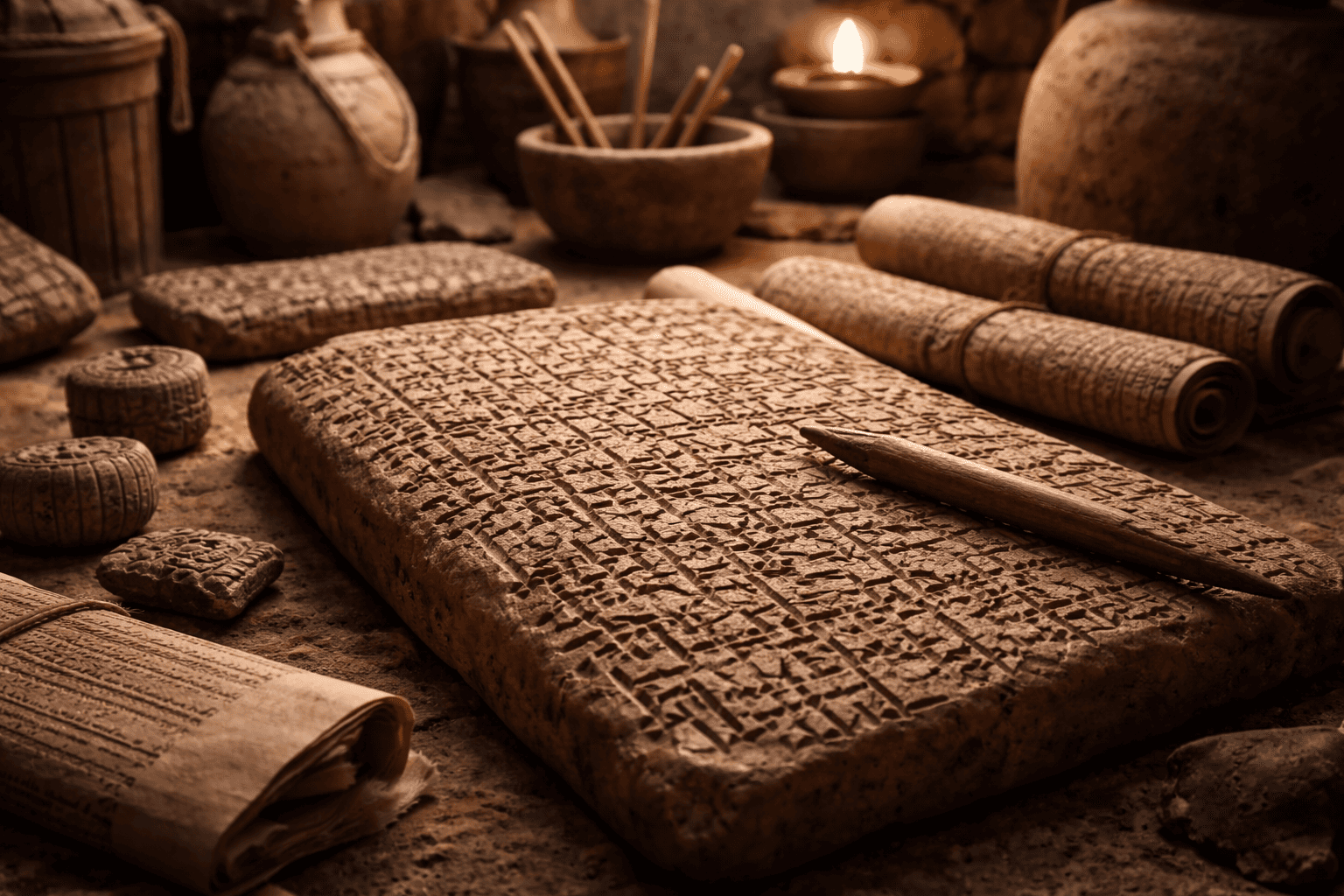
The Sumerian language exists as the earliest verified language according to our current evidence. The writing system used was cuneiform. The system involved marking symbols on clay tablets through the method of pressing.
The initial markings served practical purposes as they created lists, inventory records and trade documents. Writing evolved from its original form to include myths, laws, and narratives. The well-known Epic of Gilgamesh comes from this phase.
Sumerian exhibits three distinctive features that define its uniqueness. The language exists as a linguistic isolate because it has no verified linguistic connections. The language served multiple purposes in governmental functions, religious practices, and basic educational needs.
The language remained in use for academic purposes until 1800 BCE, when people stopped using it as their spoken language. Sumerian serves as the oldest language that people recognize today because it stands as the earliest written language.
The Gap Before Writing
What often gets overlooked is the long stretch of time before Sumerian.
Humans didn’t suddenly start communicating in 3100 BCE. Speech existed much earlier, possibly 50,000 to 100,000 years ago.
But those early forms left no physical trace.
Linguists call them proto-languages. They were likely simpler, less structured, and shaped by immediate needs, coordination, warning, and basic exchange. Over time, those systems became more complex and eventually turned into recognizable languages.
The problem is simple: no records, no certainty.
So while Sumerian is the oldest recorded language, it’s not the first language humans ever used.
Tamil: The Oldest Language Still Spoken

Shift the question slightly, and the answer changes.
If the focus is on the oldest language in the world still spoken, then Tamil becomes central to the discussion.
People have spoken Tamil without interruption since the second century before Christ. The length of time Tamil has existed in continuous use serves as a more important measurement than its basic age.
The earliest Tamil writings show their origins in 300 BCE, with both existing texts and their unchanging nature as important elements of their historical value. The language has developed through time, yet its fundamental elements remain intact.
Today, millions of people speak Tamil, which they use across different media platforms and educational settings and during their everyday interactions. People actively use Tamil because they do not keep it in broken pieces.
The reason scholars call Tamil the oldest living language in the world is that it exists as the only language that has existed since ancient times.
Egyptian: A Case of Gradual Transformation

The discussion receives an additional perspective through Ancient Egyptian art. The period started in 2600 BCE and developed through its writing system, which used hieroglyphics. The texts served as official inscriptions, religious texts, and monument inscriptions.
The Egyptian language experienced multiple transformations from its original form to Coptic through these stages:
Hieroglyphic → Hieratic → Demotic → Coptic.
The last form of Coptic existed until about the 17th century CE, but only saw limited application. The Egyptian language acquired its status as the oldest language because it maintained its existence through various adaptations. The study demonstrates how a language can endure when it undergoes continuous transformations instead of remaining unchanged.
Sanskrit: Structure and Influence

Sanskrit often enters the conversation, especially in South Asia.
It dates back to around 1500 BCE in its earliest recorded form. What sets it apart isn’t just age, but precision.
Ancient scholars, particularly Pāṇini, described Sanskrit grammar in a highly systematic way. The level of detail is still studied today in linguistics.
Sanskrit also influenced a wide range of modern languages, including Hindi and Bengali. While it’s not the oldest language in the world, its impact is difficult to ignore.
How Languages Move and Change
No language stays the same forever. Movement of people, trade routes, and empires pushes languages to adapt.
A simple example:
| Older Language | What Came From It |
| Latin | Spanish, French, Italian |
| Sanskrit | Hindi, Bengali |
| Ancient Greek | Modern Greek |
This process explains why it’s difficult to isolate a single “oldest” language. Most languages are part of a chain rather than a starting point.
Less-Discussed Observations
- Early writing systems were built for record-keeping, not storytelling
- Some languages stopped being spoken, but continued in religious or academic use
- Thousands of languages exist today, but many are at risk due to declining speakers
- There is no confirmed way to reconstruct the first human language
These points matter because they show how uneven and non-linear language history really is.
Looking Beyond a Single Answer
So, what is the oldest language in the world?
If the focus is on written history, Sumerian takes that place. If continuity matters more, Tamil stands out. If influence is the lens, Sanskrit and Egyptian both deserve attention.
The question doesn’t have a single fixed answer, and that’s not a limitation. It reflects how language actually works: evolving, overlapping, and adapting across time.
Today, understanding languages, old or modern, still requires precision. Whether it’s historical interpretation or global communication, accuracy matters. This is where services like Connected Translation become relevant, helping bridge meaning across languages without losing context.