.webp)

Translating the Metaverse: Certified Translations for Virtual Worlds & AR/VR

Summary
As immersive platforms reshape commerce, healthcare, education, and government services, language accuracy has become a major compliance and operational concern. Businesses entering AR and VR environments must ensure that contracts, onboarding materials, legal disclosures, and multilingual interactions remain accurate, culturally appropriate, and legally compliant.
This guide explains the translation and compliance risks emerging in the metaverse, the limitations of AI translation in regulated environments, and how organizations can prepare for multilingual virtual experiences responsibly.
Language Mistakes in the Metaverse Are No Longer Harmless
Virtual environments are no longer experimental platforms. Businesses are increasingly using AR and VR for onboarding, healthcare, education, financial services, training, and customer engagement.
As these environments expand globally, translation accuracy becomes a serious operational and legal concern.
Examples of risk include:
- Virtual healthcare sessions with poorly translated consent forms
- Digital contracts using incorrect legal terminology
- Safety instructions mistranslated inside immersive training systems
Immersive platforms do not eliminate legal obligations. In many cases, they increase regulatory exposure.
Organizations operating in immigration, healthcare, fintech, and legal services must still comply with requirements related to healthcare, accessibility, and official documentation.
Important compliance areas include:
- Terminology consistency
- Legal accuracy
- Cultural adaptation
- Regulatory compliance
Even in immersive environments, USCIS approved translations and official certified documents may still be required.
Key Takeaway: Virtual platforms increase the importance of accurate and compliant translation workflows.
The Unique Linguistic Challenges of AR and VR
Translation in immersive environments introduces challenges that do not exist in traditional interfaces.
Spatial Language
In VR systems, instructions are interactive and directional rather than static.
Translations involving navigation, verification, or onboarding must remain precise to avoid confusion or legal risk.
Real-Time Multilingual Communication
Virtual meetings and simulations often involve live multilingual communication.
Poor interpretation or automated translation errors may:
- Undermine negotiations
- Create confidentiality risks
- Misrepresent legal or financial terminology
Digital Identity and Documentation
Virtual onboarding and international education platforms may still require certified translations of academic records, immigration documents, or contracts.
Even in digital-first environments, compliance standards remain unchanged.
Cultural Context in Immersive Branding
Immersive environments amplify brand messaging and user perception.
Literal translation without cultural adaptation may create reputational damage at scale.
Key Takeaway: AR and VR environments require professional localization, not simple direct translation.
Myth vs. Reality: Translating the Metaverse
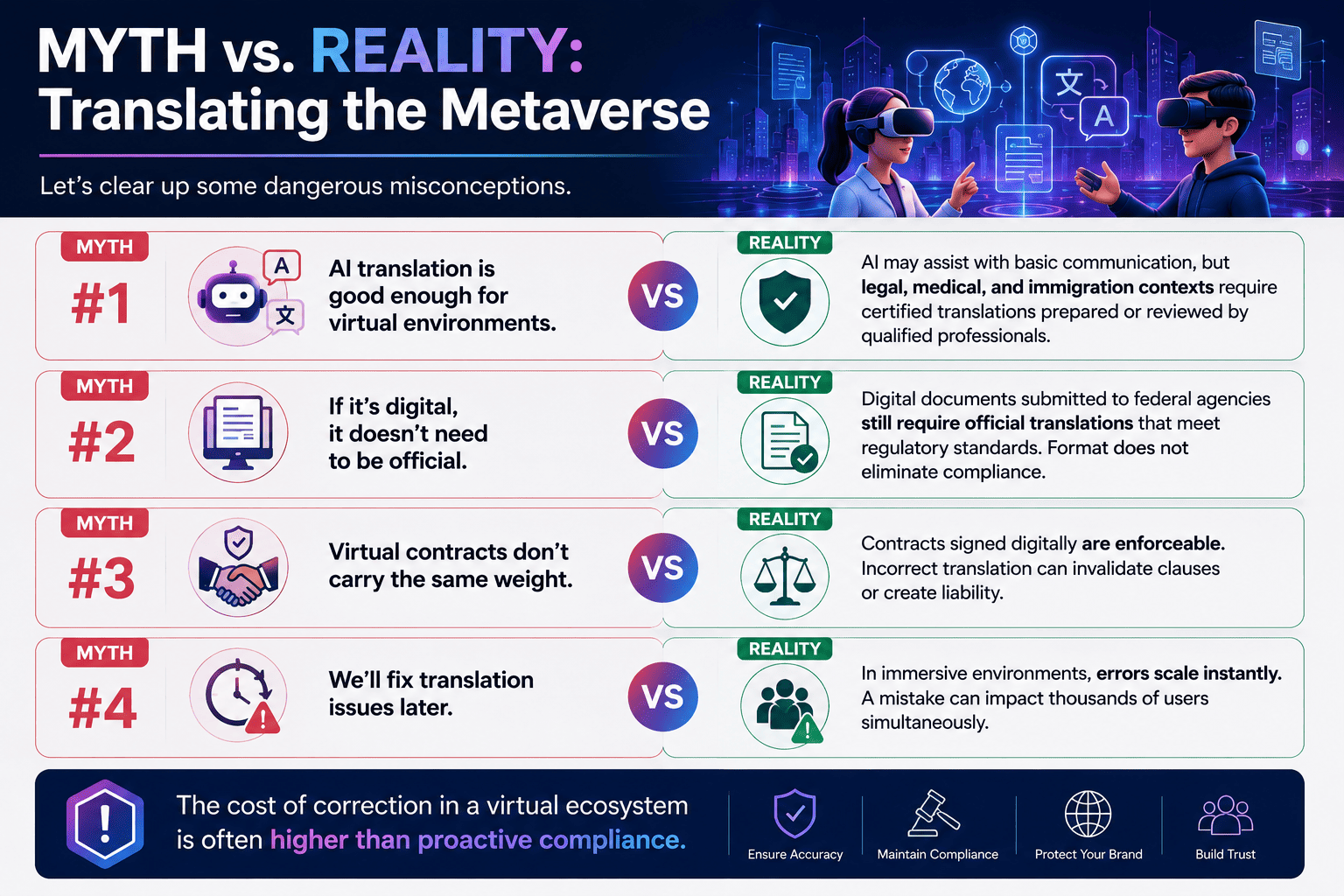
Myth: AI translation is enough for immersive environments
Reality: Legal, medical, and immigration contexts still require professional certified translation oversight.
Myth: Digital documents do not require official translation
Reality: Federal agencies still require properly certified and compliant translations.
Myth: Virtual contracts are less enforceable
Reality: Incorrect translations may still create legal liability in digital agreements.
Myth: Translation issues can be fixed later
Reality: Errors in immersive systems scale rapidly and affect large numbers of users simultaneously.
Key Takeaway: Translation failures become more expensive and visible in immersive environments.
How Businesses Should Prepare for Translation Compliance in Virtual Environments
Organizations entering immersive platforms should proactively prepare for multilingual and regulatory challenges.
1. Audit Immersive Content
Review onboarding systems, disclosures, legal notices, and multilingual interfaces for translation accuracy.
2. Separate Marketing Translation from Compliance Translation
Creative adaptation may work for marketing content, but legal and regulatory documents require strict accuracy.
3. Standardize Terminology
Ensure consistent terminology across websites, mobile apps, VR environments, and blockchain systems.
4. Maintain Compliance Documentation
Organizations should maintain records showing that translations were completed and reviewed by qualified professionals.
5. Integrate Translation Early in Product Development
Translation and localization should be incorporated during UX and platform design rather than after launch.
Key Takeaway: Early translation planning reduces compliance risk and long-term operational costs.
Conclusion
The metaverse does not eliminate legal, cultural, or regulatory responsibilities. It introduces new interfaces where those responsibilities become more visible and more complex.
Certified translations, official documentation, and multilingual compliance remain essential for organizations operating across borders and immersive digital environments.
Businesses expanding into AR and VR should treat translation as critical infrastructure rather than a final-stage task.
At Connected Translations, we provide professional certified translation and localization services designed for legal, immigration, healthcare, and global digital environments.
Key Takeaways
- Immersive platforms increase translation and compliance risks
- Certified translations remain essential in digital environments
- AI translation tools cannot replace professional compliance oversight
- Proactive localization strategies reduce operational and legal exposure