.webp)

Chinese vs Japanese in International Business Communication: What You Need to Know

Summary
In the world of international business, communication is key to success. But when you’re dealing with different languages, choosing between Chinese and Japanese can have significant implications. While both languages have similarities, they also feature major differences. This post will break down the essential distinctions between Chinese and Japanese, providing insights into which one is more appropriate for your business needs, and why professional translation services are crucial to avoid costly mistakes.
Why Understanding the Difference Between Chinese and Japanese Matters for Your Business
| Linguistics | Chinese | Japanese |
| Language | Chinese is a member of the Sino-Tibetan language family, and Mandarin Chinese is the most common dialect. | Japanese is a member of the Japonic language family and is not closely related to Chinese, although it has borrowed many Chinese words. |
| Characters | Chinese uses Hanzi, or logograms. Each character denotes a word or morpheme, and there are thousands of characters. Mastering Chinese characters takes years, if not decades of practice. (Unlike an alphabet system in which a few dozen letters are used to represent words, Chinese characters are logograms, meaning each character is a word or morpheme). | Japanese has three different scripts. Kanji is similar to the Chinese writing system, although the characters often represent different words and have different pronunciation. Hiragana and Katakana are phonetic scripts used for native and non-native words, respectively. Katakana is used for foreign loan words, and Hiragana is used for native words. |
| Tones | Chinese is a tonal language, and the tones are used to distinguish words from one another. Mandarin Chinese uses four tones. Mastering the tones in Chinese is difficult for many foreigners. | Japanese is not a tonal language in the same way Chinese is. Although pitch accent is important in Japanese, it is not used in the same way Chinese tones are. |
| Grammar | Chinese grammar is simpler than Japanese grammar. Chinese does not use verb conjugation or tense, whereas Japanese relies heavily on both. Chinese does use word order, however, and usually follows a subject-verb-object order. | Japanese grammar is more complicated than Chinese grammar because of its verb conjugation and tense system. It also has a system of honorifics, or different levels of politeness. Japanese usually follows a subject-object-verb word order. |
1.Why Does This Matter for Your Business?
Understanding the above differences is important for business communication in each market. Using the wrong language, misusing honorifics, or using the wrong tone can offend clients and cause communication errors. Understanding the cultural context of each language, as well as the grammar, characters, and tones of each language, is important for communicating effectively.
2.When to Use Chinese and When to Use Japanese for Your Business
Here are some of the factors to consider when deciding whether to use Chinese or Japanese for your business:
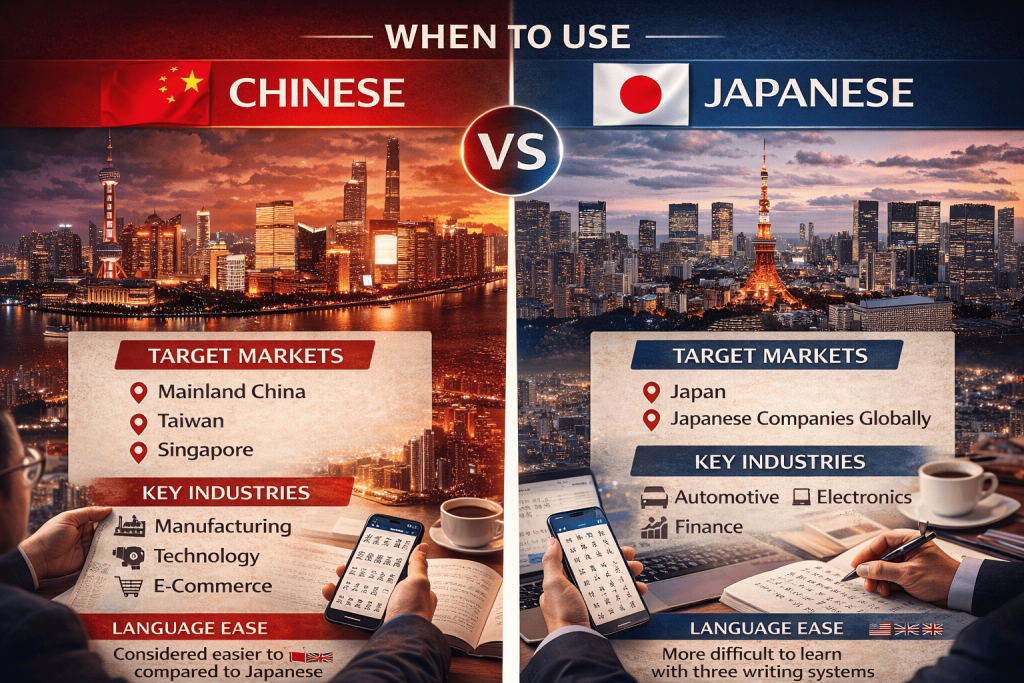
Target Market: China is a huge global market and Mandarin Chinese is the most spoken language in the world. If you are targeting mainland China, Taiwan, or Singapore, you will need to use Mandarin Chinese. Japan has a highly developed economy and is one of the largest trading partners of many countries. If you are targeting the Japanese market or working with Japanese companies elsewhere, you will need to use Japanese.
Business: Chinese is a good choice for manufacturing, technology, or e-commerce businesses, given China’s influence in those industries. It’s also a good choice for any businesses targeting mainland China. Japanese is a good choice for automotive, electronics, or financial businesses, since Japan has traditionally dominated in those industries. Japanese is also a good choice for businesses targeting the Japanese market.
Language: If your team is more proficient in Chinese, use Chinese. If your team is more proficient in Japanese, use Japanese. For English speakers, Chinese is relatively easier to pick up compared to Japanese, in terms of grammar. Japanese is much harder as there are three writing systems to learn.
Conclusion: If your business involves both countries or many countries in Asia, you may need to communicate in both languages. In such a case, find a translation agency that has a Chinese and Japanese translation team.
3. The Importance of Translation Services
Whether you are communicating in Chinese or Japanese, translation services are a must.
Cultural context: Both languages have cultural implications. For instance, in Japan, it is expected to use the polite forms and honorifics when communicating in a business context. The professional translator will be able to provide this nuance.
Translation of business terms: Business terminology such as finance, law and technology require the services of a professional who is well conversant with the terminology.
To avoid errors: You may make errors while translating that may cost you so much in terms of marketing, contract errors and legal documents. The translation agency will help you avoid such errors.
How Can Connected Translations Assist?
We are a translation agency that provides both Chinese and Japanese translation services. Whether you need translation of your legal documents, websites, marketing materials, business cards among others, we are here to assist.
4. The Influence of Chinese and Japanese on Global Business
Both Chinese and Japanese have had a great influence on global business. In this section, we shall look at how both languages have influenced the global market.
Chinese: China is increasingly becoming a global power and as such, the Chinese language has become a global language of business. If you are doing business in China, for instance, in trade, technology and manufacturing, you need to learn how to communicate in Chinese. China is also a key player in the global supply chain and speaking the language can help you communicate with your suppliers, manufacturers and customers.
Japanese: Japan is a global leader in technology, automotive and finance. Though not as popular as Chinese, Japanese is also an essential language especially if you want to do business with the Japanese. For instance, if you want to penetrate the Japanese market or enter into a business deal with giants such as Toyota, Sony and Mitsubishi, you need to learn how to communicate in Japanese.
Example
There is an example of an America business man who was expanding his business to the Chinese market. He launched a new product in the market but the translation was poor and as such, the Chinese could not understand what the product was all about. He incurred heavy losses and his business image was highly tarnished. Such a scenario can be avoided by hiring the services of a professional translation agency.