.webp)

First Words Ever Spoken: The Origin of Human Language

Summary
What were the first words ever spoken? How did human language evolve from grunts and gestures to complex sentences? This blog explores the origins of human language, the evolution of communication, and the possible first words spoken by early humans.
While we may never know the exact first words, understanding this journey helps explain why language remains so important for translation, cross-cultural communication, legal accuracy, and global business communication today.
Introduction: The First Words Ever Spoken
Have you ever wondered what the first words ever spoken were? Was it a simple “hello,” a request for food, or something more practical?
While we may never know the exact words spoken by the first humans, the development of language is one of the greatest achievements in human history. These early words helped strengthen bonds between individuals, support shared understanding, and enable the rise of civilizations.
For businesses, educators, and linguists, understanding the roots of language is valuable for everything from translation to cultural appreciation. This article explores the journey of human language and its significance for global communication.
The Origins of Human Language
The origins of human language remain difficult to trace, but anthropologists generally agree that language likely evolved gradually over thousands of years.
Early humans probably communicated using vocalizations, facial expressions, and physical gestures. Some researchers suggest that the first words were simple sounds connected to emotions or essential needs such as food, safety, or companionship.
Key points to consider:
- Early humans likely used vocalizations and gestures for basic communication
- Language gradually evolved as humans developed abstract thought and more complex social structures
- The shift from non-verbal communication to verbal language marked a major milestone in human development
The development of language is considered one of the most important advances in human evolution. It allowed early humans to pass on knowledge, establish social bonds, and create cultures.
Key Takeaway: Human language likely began with simple sounds and gestures before gradually developing into structured speech.
Theories Behind the First Words Spoken
While we may never know exactly what the first words were, linguists have proposed several theories about how language began.
One widely discussed theory is the gestural theory, which suggests that language may have started with hand gestures before developing into vocal communication. As humans became more capable of producing and controlling sounds, gestures were gradually supported or replaced by spoken words.
Another well-known theory is the Bow-Wow theory, which suggests that language began when humans imitated sounds from nature. Early words may have been based on sounds associated with animals, objects, or actions, such as the bark of a dog or the rustling of leaves.
Other theories include:
- Ding-dong theory: Words developed as natural responses to sounds or objects
- Yo-he-ho theory: Language developed from sounds used during collective labor
While these theories offer possible explanations, the exact first words spoken remain speculative.
Key Takeaway: The first words may have developed from gestures, natural sound imitation, or sounds used during social cooperation.
The Evolution of Language and Communication
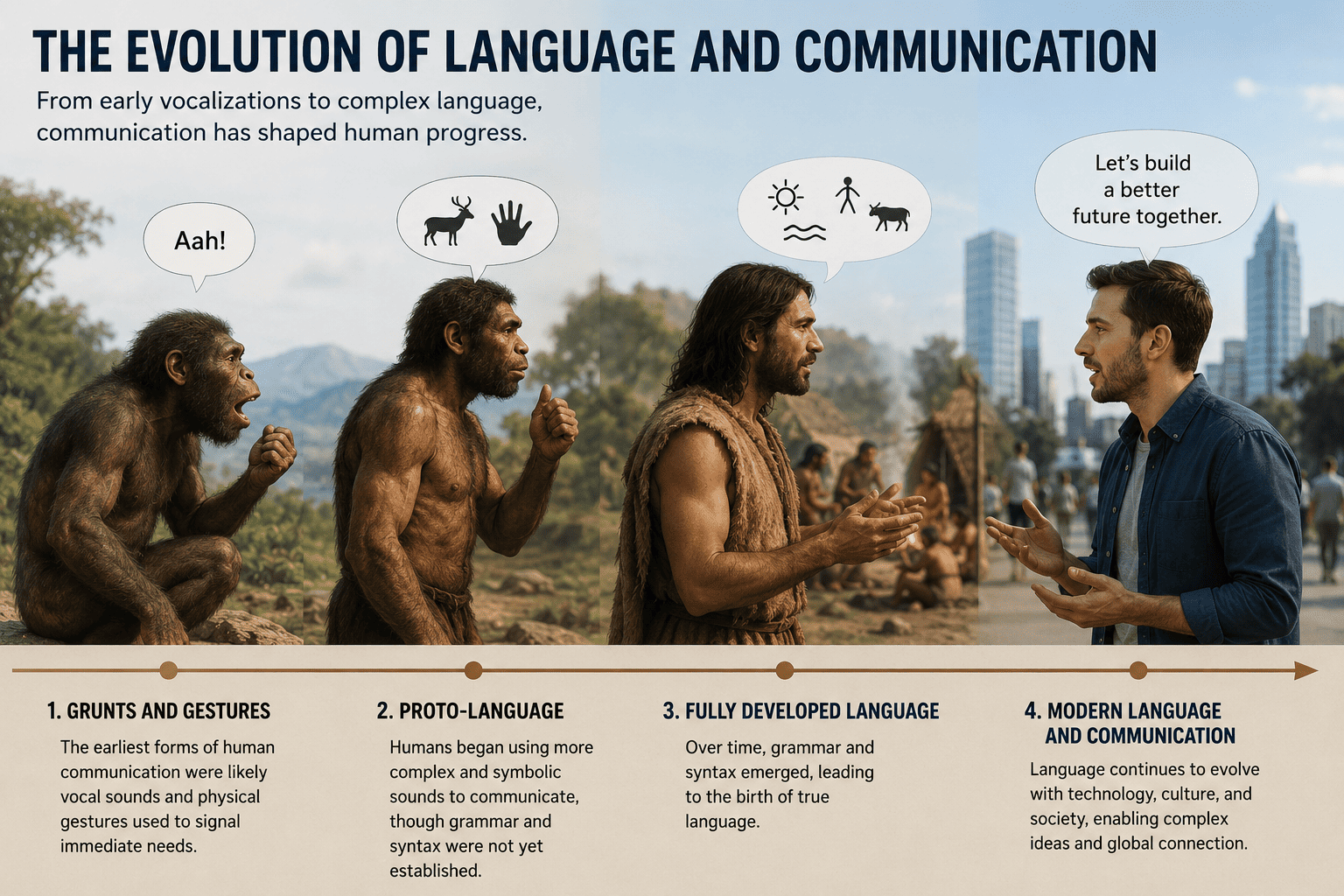
As humans developed, so did their methods of communication. Early vocalizations and gestures gradually evolved into more sophisticated forms of communication as human societies grew.
The shift from simple sounds to structured language likely followed the same path as early human development. It was driven by the need for cooperation, social connection, and problem-solving.
Key milestones in language evolution:
- Grunts and gestures: The earliest forms of human communication were probably vocal sounds and physical gestures used to signal immediate needs
- Proto-language: Humans began using more complex and symbolic sounds to communicate, though grammar and syntax had not yet fully developed
- Fully developed language: Over time, grammar and syntax emerged, leading to the development of true language
This evolution was influenced by human brain development, stronger social structures, and the increasing complexity of human societies.
Key Takeaway: Language evolved as humans needed better ways to cooperate, solve problems, and build communities.
The First Words and Their Impact on Modern Communication
The development of language, beginning with the first words spoken, played a major role in shaping modern communication.
Language allowed early humans to form communities, share knowledge, express ideas, and build social systems. As language became more complex, it laid the foundation for the diverse languages spoken across the world today.
The first words spoken were important because they helped shape culture and society. Through language, humans could pass down traditions, explain experiences, and communicate more effectively.
In modern times, language remains central to communication, especially in business and legal contexts, where precise wording is essential.
The significance of the first words:
- The first words helped humans communicate, share ideas, and form cultures
- Language remains central to modern communication in business, education, and legal proceedings
- Clear communication today depends on the long evolution of language
Key Takeaway: The first words helped create the foundation for culture, cooperation, and modern communication.
The Impact of Language on Translation and Communication
In today’s globalized world, language plays a vital role in international communication. For businesses and individuals operating across borders, the ability to communicate clearly and accurately is essential.
Mistranslations can lead to costly errors, especially in legal documents, contracts, employee materials, or marketing content.
Common challenges in translation include:
- Cultural and linguistic differences: Misinterpretations can happen when cultural context is not considered. A word or phrase in one language may carry a different meaning when translated into another language
- Legal translation: Legal documents, including contracts and policies, must be translated with precision to avoid misunderstandings, compliance issues, or legal disputes
Real-world example:
A U.S. company expanding into Latin America needed to translate contracts and employee handbooks. Because of legal and cultural differences in language, the company hired professional legal translators to ensure the documents were legally accurate and culturally appropriate. This helped avoid legal disputes and supported compliance with local regulations.
Key Takeaway: Accurate translation protects meaning, reduces risk, and supports stronger cross-border communication.
Conclusion: The Importance of Language in Global Communication
The first words spoken by early humans were more than a way to express immediate needs. They marked the beginning of a transformative journey that led to the development of complex languages, cultures, and societies.
Understanding the origins of language helps us appreciate the importance of precise communication, especially in legal, business, and cross-cultural contexts.
For businesses and individuals operating internationally, accurate translation is essential for building trust, reducing misunderstandings, and communicating effectively across cultures.
At Connected Translations, we provide high-quality translation services that are linguistically accurate and culturally relevant. Our team of certified translators understands the differences between languages and helps ensure your documents meet high standards of accuracy and legal compliance.
Key Takeaways
- The first words ever spoken cannot be known with certainty
- Human language likely evolved from gestures, sounds, and early social communication
- Language helped early humans form communities, cultures, and shared knowledge
- Modern translation depends on cultural context, legal precision, and linguistic accuracy
- Professional translation services help businesses communicate clearly across borders