.webp)

What Country Has the Oldest Language in the World?

Summary
Which country has the oldest language in the world? This is a question with no simple answer, as both spoken and written languages have evolved over millennia. In this blog, we’ll take a look at some of the oldest known languages, from the first written texts to the spoken languages that laid the foundation for modern languages. Let’s explore which one can claim the title of the world’s oldest language.
1. What Is the World’s Oldest Language?
Answering the question of the oldest language isn’t straightforward because languages can be spoken and written. Some languages have been spoken for thousands of years, while others have evolved into different forms or become extinct. To determine the oldest language in the world, we need to consider both spoken and written languages.
A. Oldest Written Languages
When discussing the oldest written languages, we refer to the earliest written texts recorded by the first human civilizations. Here are some of the oldest written languages:
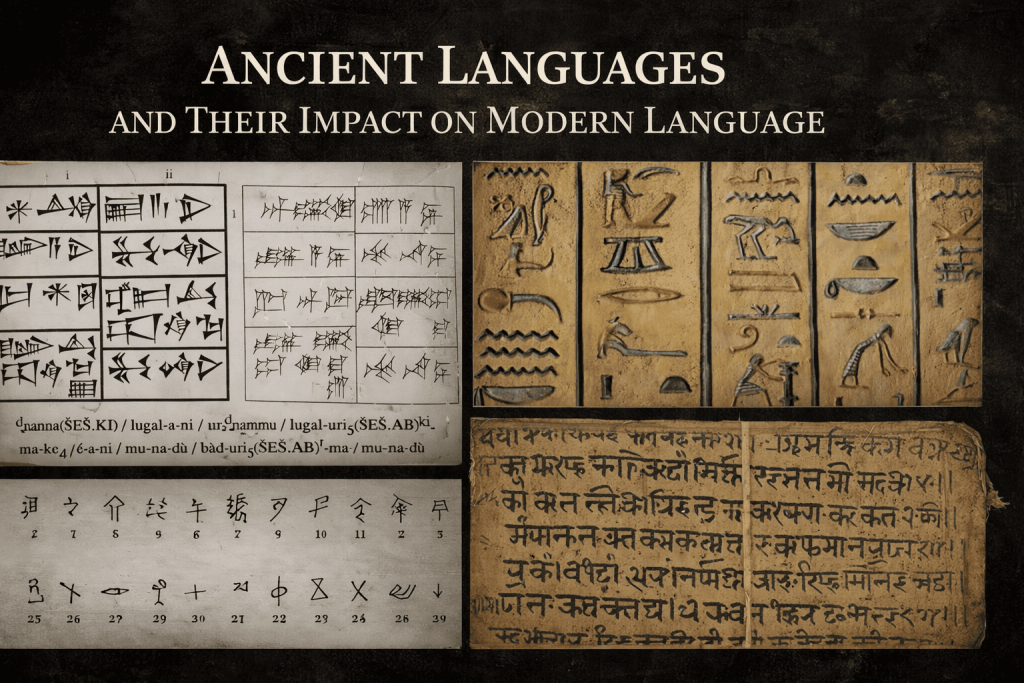
- Sumerian: The Sumerians, who lived in ancient Mesopotamia (modern-day Iraq), are said to have created the cuneiform script around 3200 BC. Sumerian is considered one of the oldest written languages, though it is a “dead” language today—meaning it is no longer spoken.
- Egyptian Hieroglyphs: The ancient Egyptians developed their hieroglyphic script around 3300 BC, making it one of the oldest written languages associated with one of the world’s oldest civilizations. Though Egyptian hieroglyphs evolved into Coptic, this writing system is still used in some religious contexts.
- Akkadian: Akkadian was used in ancient Mesopotamia and is the first known Semitic language to have been written. Texts written in Akkadian have been found dating back to around 2500 BC.
B. Oldest Spoken Languages
When considering spoken languages, the situation is more complex, as many of the oldest languages are still spoken today. Here are some of the oldest spoken languages in the world:
- Tamil: Tamil is considered one of the oldest continuously spoken languages. Spoken in southern India and Sri Lanka, Tamil has a history of more than 2,000 years. Its literary tradition dates back to around 500 BC, making it one of the world’s oldest living languages.
- Chinese: The Chinese language has a history of over 3,000 years. While the modern form, Mandarin Chinese, has evolved over time, it is rooted in Classical Chinese, which was spoken and written long before the Shang Dynasty (1600 BC). Chinese characters have not changed significantly for thousands of years, making it one of the longest-living written languages in the world.
- Hebrew: Biblical Hebrew dates back more than 3,000 years. Though it’s not spoken in everyday life, Modern Hebrew is still spoken by millions today, particularly in Israel, where it has been revived as a spoken language in recent centuries.
Why This Matters for Understanding Human History
The oldest languages provide important clues about the development of human civilization. They were not only used for communication but also for the creation of writing systems, laws, art, and science. Studying these ancient languages helps us understand how early societies operated, passed down knowledge, and influenced the languages we use today.
2. Ancient Languages and Their Impact on Modern Language
While many of the oldest languages are no longer spoken in their original forms, they continue to influence modern languages. Let’s take a look at how these ancient languages have impacted modern communication and writing systems.
A. Sumerian
Sumerian is widely regarded as the first written language. The invention of cuneiform script allowed the Sumerians to document their laws, literature, and economic activities. This writing system influenced later cultures like the Akkadians, Babylonians, and Assyrians, and paved the way for the development of other writing systems, including alphabets.
B. Egyptian Hieroglyphs
The Egyptians used their hieroglyphic system around the same time as the Sumerians. Though hieroglyphs were pictorial representations, they influenced the development of later writing systems, including the Phoenician alphabet, which is considered the precursor to most modern alphabets. Hieroglyphs also influenced Latin and Greek characters.
C. Ancient Chinese
The Chinese language has had a profound influence on East Asia. The earliest Chinese written records, such as the oracle bone script, date back to the Shang Dynasty. Modern Chinese characters are a direct descendant of these early symbols. While spoken Chinese has undergone significant transformations, the writing system has remained relatively consistent and has influenced other East Asian languages like Japanese and Korean.
D. Sanskrit and Indian Languages
Sanskrit, an ancient language spoken in India and Southeast Asia, has a long literary tradition. Although Modern Sanskrit is not commonly spoken, it is still used in religious and ceremonial contexts. Hindi, Bengali, and Marathi are among the many Indian languages that have evolved from Sanskrit. Sanskrit has also influenced languages in other parts of Asia.
Why This Matters for Modern Language
The development of Sumerian, Egyptian hieroglyphs, Chinese, and Sanskrit laid the foundation for the languages we speak today. These ancient languages have helped shape modern writing systems, alphabets, and even entire language families. Understanding how ancient languages evolved and influenced each other enriches our appreciation for modern communication and the written word.
3. Which Country Has the Oldest Language?
Determining the country with the oldest language depends on whether we consider spoken or written languages, as well as whether the language is still in use today. Let’s examine a few countries that have ancient languages still in use:
A. India and Tamil
India is home to Tamil, one of the world’s oldest living languages. Tamil has a long literary tradition dating back over 2,000 years and continues to be spoken by millions today. It holds special significance in India, where it is recognized as a classical language and used in both literature and daily life.
B. China and Chinese
China boasts a language with over 3,000 years of history. The written Chinese language, which evolved into Mandarin, is one of the world’s oldest and most enduring. The modern Chinese language is rooted in Classical Chinese, and Chinese characters have remained largely unchanged for millennia, making it one of the longest-living written languages.
C. Greece and Ancient Greek
Ancient Greek is another contender. Though Modern Greek is still spoken today, Classical Greek laid the foundation for much of Western philosophy, science, and literature. While it is no longer spoken in its original form, Ancient Greek continues to be studied in academic and religious settings.
Why This Matters for Language Learners
Understanding the oldest languages gives learners a deeper connection to the culture and heritage of the language. Whether you’re learning Mandarin to communicate with Chinese speakers or Tamil to connect with India’s rich literary history, knowing the roots of these languages adds context and depth to your studies.
4. How to Study the World’s Oldest Languages Today
If you’re interested in learning or studying one of the world’s oldest languages, there are several ways to get started:
- Learn Modern Forms: While languages like Sumerian and Akkadian are no longer spoken, you can learn Classical Chinese, Sanskrit, or Latin, which are still taught in universities and are useful for understanding ancient texts.
- Language Immersion: If you’re looking to learn an ancient language still spoken today, such as Tamil or Mandarin, immersion in the culture and language will help you master the language.
- Use Language Resources: Many universities offer courses in ancient languages, and there are numerous online communities and resources that can help you learn. Libraries, museums, and academic centers often have materials that allow you to study these languages.
Why This Matters for Aspiring Linguists
Studying the oldest languages provides invaluable access to ancient cultures and texts. Whether you’re interested in linguistic research, history, or cultural exploration, learning these languages connects you to a deeper understanding of human expression, philosophy, and history.